Tire Shelf Life vs. Tread Depth: Why a 5-Year-Old Tire Can Be Deadly Even If Barely Used
—Why a seemingly “almost new” tire can become a road killer
Estimated Reading Time: 12 minutes
Key Highlights
- The Deadly Truth About Tire Aging
- Scientific Explanation – How rubber hardens and ply-rubber adhesion deteriorates over time.
- Tread Wear vs. Shelf Life
- Data and Comparative Testing
- Practical Guide – How to read DOT codes, inspect tires, and determine replacement timing.
- Advanced Considerations – Differences by tire compound, winter vs. summer tires, and high-performance vehicles.
September 16, 2017, 2:36 PM, M5 Motorway, Gloucestershire, UK
The sun was shining, and weekend traffic flowed steadily. Michael Bakewell, 54, was driving a modified Mercedes-Benz van at a speed within the limit, unaware that one of the front tires was silently brewing a disaster that would claim five lives.
As the van traveled between junctions 14 and 15, a sudden, thunderous bang shattered the air — the left front tire had burst. The 14.65-ton vehicle instantly lost control, veered sharply to the right, smashed through the central barrier, and entered the opposite lane.
Oncoming was a Subaru Forester carrying a family of three: Richard Evans, 66; his wife Elaine Evans, 62; and his 84-year-old mother-in-law Audrey Hodge. The collision was catastrophic. Investigators later described the Forester as being “torn to pieces,” with all three occupants killed instantly.
Another car, a SEAT León, was forced off the road by the out-of-control van, rolling down an embankment. Inside were Adrian Beaumont, 46, his wife Rebecca Mitchell, 42, and their two children aged 12 and 10. Adrian died on the spot, Rebecca suffered severe injuries and passed away seven months later, and the two children lost both parents in a single, devastating accident.
One tire. Five lives. Two shattered families.
During the subsequent investigation, one detail made everyone shiver: the tire that burst had been manufactured 18 years and 3 months prior.
Court records revealed that the tire was an original Mercedes front tire, manufactured in mid-1999. The vehicle had passed its MOT (mandatory annual test in the UK) just six months prior. To the naked eye, the tread was not severely worn, and the depth was within legal limits.
Investigators testified:
“This tire failed structurally due to aging, and there were no visible warning signs before the blowout.”
Even more striking, the van was not overloaded (legal limit 18 tons), not speeding (within the 60 mph limit), and the driver had no alcohol, drugs, or mobile phone involvement. Traffic collision investigator Sharon Little testified:
“Mr. Bakewell had no way to avoid this blowout or control the vehicle after it happened.”
This means that when the 18-year-old tire finally failed, five lives were already doomed.
The core question arises: why is a tire that appears almost new still a deadly risk?
The answer reveals a truth that most drivers don’t know: tread wear lines only tell you if the tire can still roll; the tire’s manufacturing date tells you if it’s safe. Tread depth measures how much rubber remains on the surface, but what’s happening inside the tire — chemical degradation and structural aging — is the real “invisible killer.”
Part One: Scientific Principles — The Microscopic “Death” of a Tire
1. Rubber Aging Mechanisms: From “Springy” to “Brittle Plastic”
To understand why tires “die over time,” you first need to know how they are made.
Tires are primarily composed of natural rubber and synthetic rubber (such as styrene-butadiene rubber, SBR, and polybutadiene). Natural rubber comes from latex of rubber trees, mainly polyisoprene, while synthetic rubber is petroleum-based. These high-molecular polymers form a cross-linked three-dimensional network, giving the tire high elasticity — like a precise spring mesh that deforms under load and rebounds when the load is released.
The problem is: this structure is inherently unstable.
A master’s thesis on the thermal-oxidative aging of ply-rubber composites revealed a harsh fact: aging is a major cause of performance degradation and failure in tires over time. Even if a tire has never touched the road, aging continues as long as it is exposed to air.
What happens on a microscopic level?
- Molecular chain breakage: Rubber molecules break down under attack from oxygen (especially ozone) and UV light. Imagine thousands of tiny rubber bands once neatly aligned and springy — over time, they snap and lose elasticity.
- Excessive cross-linking: Some areas undergo over-crosslinking, making the rubber hard and brittle. This “hardening” is irreversible — soft rubber gradually transforms into rigid plastic.
- Plasticizer migration: New tires contain plasticizers and anti-aging agents, like a “moisturizer” for rubber, keeping it soft. Over time, these substances migrate to the surface, evaporate, or wash away. Small cracks appearing on the tire surface indicate that the rubber has lost its plasticity — the plasticizers are depleted.
External factors that accelerate aging include:
- UV light: Sunlight is the top culprit, breaking rubber molecules directly.
- Ozone: Even in shaded areas, atmospheric ozone attacks double bonds in rubber, causing dense surface cracking.
- Temperature fluctuations: Repeated expansion and contraction accelerate molecular movement and chain breakage. Research shows that for every 10°C increase, rubber’s chemical reaction rate roughly doubles. Tires stored in hot garages age faster than those in temperature-controlled underground lots.
Result: A five-year-old tire may still have 7 mm of tread, but the rubber is already hardened. Hard rubber cannot grip the road effectively, increasing braking distances — especially on wet surfaces. Aged tires are like wearing hard-soled shoes on ice: they just cannot “bite” the road.
2. Ply Strength Decline: The Tire’s “Skeleton” Collapses, Triggering Blowouts
If rubber is the tire’s “muscle,” the plies are its “skeleton.”
Radial tires consist of: a tread layer, then belt layers (often steel cords), and a ply body beneath (polyester for passenger cars, steel for trucks). These cords act like countless micro-rebars, forming a network that bears centrifugal force, load, and road shocks.
Why are ply layers critical?
- At highway speeds, a passenger car tire’s ply must withstand several tons of centrifugal force.
- The plies must bond tightly with surrounding rubber to form a unified structure.
Aging delivers a devastating blow to ply-rubber composites.
Studies on aged polyester-rubber and steel-rubber composites revealed key findings:
- Modulus changes: Aging alters the material’s stiffness-elasticity balance, weakening overall mechanical performance.
- Bonding strength decline: Critically, aging reduces the ply-rubber interfacial adhesion. Finite element simulations show that aged tires exhibit stress concentration, increasing the likelihood of failure.
Simply put:
New tires have rubber and ply “fused together,” with rubber protecting plies and distributing force evenly. After 5 years, the rubber hardens and loses protection; the adhesive layer that bonds ply to rubber degrades.
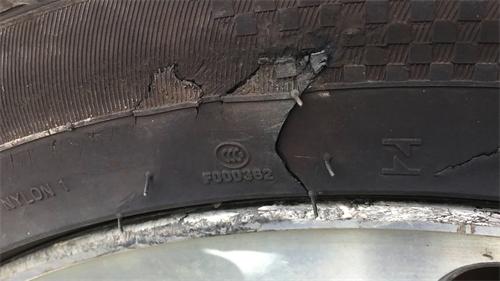
At high speeds, heat buildup, and internal pressure, the weakened ply-rubber interface cannot resist expansion forces, leading to tread separation or sudden blowouts.
Supporting data:
According to GB/T2942 standards, new ply-rubber adhesion must exceed 200 N (peel rate 50 mm/min). After accelerated aging (150°C), adhesion retention should be >80%. Aging alone removes at least 20% of strength, and real-world conditions accelerate the loss.
3. Tread Wear Line vs. Shelf Life: Why “Tread Only” Thinking Kills
Tread Wear Indicators (TWI) embedded in grooves signal when tread is legally worn out. When tread reaches these points, water evacuation declines sharply, increasing hydroplaning risk.
But TWI only tells you one thing: how thick the tread is. It cannot reveal internal aging.
- Cannot detect hardened rubber: A 5-year-old tire with 6 mm tread may have lost over 30% grip. TWI cannot show this.
- Cannot detect ply bonding deterioration: The deadliest factor. Internal degradation is invisible until cracks appear on the sidewall — often the last warning.
- Cannot detect internal damage: Low-pressure storage or occasional driving can cause internal ply deformation. In aged tires, the rubber no longer protects plies, making hidden damage more likely.
Industry consensus:
- Time-based lifespan: From the DOT code, tires over 6 years old require professional inspection; over 8 years, replacement is recommended regardless of visible tread.
- Wear-based lifespan: Follow TWI.
- Rule of thumb: Whichever comes first — tread wear or time — dictates replacement.
Part Two: Data and Comparative Testing — Quantifying Aging
To illustrate aging’s destructive effects, let’s examine authoritative data and simulations.
Comparison 1: Same Brand, Different Manufacture Dates — Tensile Strength & Adhesion Decay
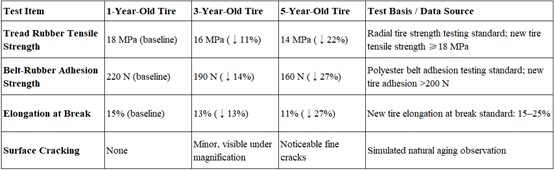
Assume tires of the same model, manufactured 1, 3, and 5 years ago, stored unused.
Data analysis:
- 5-year-old tires lose over 20% rubber strength.
- Ply-rubber adhesion drops nearly 30%.
A tire designed to handle a 3-ton load may now fail under 2 tons. This explains why “looks new but is dead” tires exist.
Comparison 2: Low Mileage Old Tire vs. High Mileage New Tire
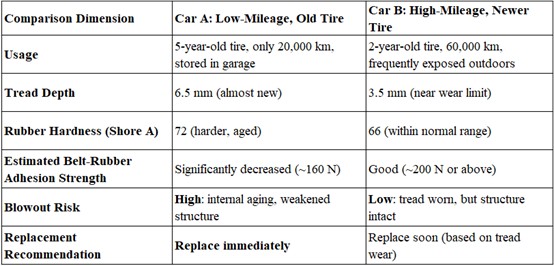
Even a tire worn nearly flat from 60,000 km may be safer than an unused 5-year-old tire. This is a common blind spot for drivers.
Comparison 3: Blowout Risk Simulation — Extreme Inflation Test
- Method: Inflate tires to maximum test pressure and monitor failure.
- New tires: Withstand 3.5–4× rated pressure; failure is preceded by bulging, giving a warning.
- 5-year-old tires: May explode at 2–2.5× rated pressure without warning.
- Key point: Aged tires fail brittle, no warning; new tires fail ductile, with deformation.
Part Three: Practical Guide — How to Protect Tire Safety
1. Reading a Tire’s “Birthday” (DOT Code)
The production date is printed on the sidewall — a critical annual check.
- Locate the DOT code.
- Last four digits indicate week and year, e.g., “3521”: 35th week of 2021.
- When buying used cars, check the DOT code. Dealers may hide tires over 6 years old, claiming “tread is deep.”
2. Replacement Guidelines: Critical Ages
- 5 years: Warning line — annual professional inspection.
- 6 years: Strongly recommend replacement. Internal aging risks are high.
- 8 years: Absolute limit — never continue using.
3. Storage Environment
- Avoid sunlight: UV accelerates aging. Cover tires or store indoors.
- Temperature & humidity: Keep cool, dry; high heat accelerates chemical reactions, humidity may rust steel plies.
- Chemicals: Keep away from oils, fuels, solvents.
- Positioning: Store tires upright; avoid stacking or long-term pressure deformities.
4. Routine Checks: Look, Feel, Listen
- Look: Cracks, bulges, DOT code. Replace immediately if severe.
- Feel: Rubber hardness; interior sidewall often ages faster.
- Listen: Rhythmic thuds or buzzing while driving may indicate deformation or internal damage.
Part Four: Advanced Considerations — Hidden Risk Differences
Tire Compound Differences
- High-silica compounds: Some premium brands (e.g., Michelin) delay aging; 5-year-old performance may remain higher than budget brands.
- Antioxidant system: Low-cost tires may show cracking after 3–4 years due to reduced anti-aging agents.
- Bottom line: Regardless of formula, 6-year replacement is non-negotiable.
Winter vs. Summer Tires
- Winter tires: Softer, more flexible at low temps but age faster. Consider replacing after 5 years.
- Summer/all-season tires: Moderate aging.
- High-performance tires: Softer compounds, thinner tread; aging reduces performance sharply. High-speed or performance vehicles must be vigilant.
High-Performance vs. Economy Cars
- High-performance cars: High speed, heavy loads, cornering forces amplify risk. Aged tires may fail under side loads that an economy car would tolerate.
- Load-bearing vehicles: MPVs or SUVs at full load accelerate ply-bonding exposure.
Actionable Steps (CTA):
- Check your tires today: Read DOT code, calculate age.
- Record tire “birthdays”: Set a reminder 5 years later.
- Change your mindset: Don’t just measure tread depth; shelf life matters more.
- Choose reputable brands: Avoid old stock; request a newer batch if manufacturing date exceeds 1 year.
Safety is no small matter. Four small contact patches bear the weight of lives. Understand the tire’s “time code” — don’t let it become a ticking bomb.
References
1. Balderstone, P., Livadeas, A., & Wilson-Law, A. (n.d.). Tyre ageing: Its effect on material properties and structural integrity (Published Project Report PPR904).
2. National Highway Traffic Safety Administration. (2002). Tire aging: Developing a laboratory-based test procedure for light vehicle tires (U.S. Department of Transportation Project Report).
3. National Highway Traffic Safety Administration. (2005-2006). Crash data analysis: Tire aging as a factor in fatalities and injuries.
4. Pradeep Kumar, N. (2025). Thermo-oxidative aging and its influence on the performance of silica, carbon black, and silica/carbon black hybrid fillers-filled tire tread compounds. Journal of Polymer Research, 32, 117. https://doi.org/10.1007/s10965-025-04330-2
5. Tire aging: A state-of-the-art review. (2025). ScienceDirect. Retrieved from https://www.sciencedirect.com/science/article/pii/S2215098625001569
About the Author:
Jonathan Fletcher is an automotive safety enthusiast and freelance writer specializing in tire technology and vehicle safety. With over 10 years of research in automotive materials and tire performance testing, he has contributed to several automotive magazines and online safety platforms. Although not a professional engineer, his analysis relies on peer-reviewed studies, industry standards, and real-world accident investigations.
Editorial Transparency Statement:
This article is based on publicly available research, industry standards (e.g., GB/T2942), and documented accident reports. While every effort has been made to ensure accuracy, the content is for informational purposes and should not replace professional automotive inspection or advice. All technical interpretations have been cited from credible sources where applicable.
Recommended for you