My First 1,000 Miles With the 2025 Ford Mustang Dark Horse — Daily Driving a Track-Focused Muscle Car
Estimated Reading Time: 8–10 minutes
Key Highlights
- Beast Profile: Technical overview of the 2025 Ford Mustang Dark Horse
- First 1,000 Miles: Real-world experience covering city commuting, highway cruising, and canyon roads.
- Track & Performance Impressions: Acceleration, cornering, braking, and handling compared to Mach 1, BMW M3, and Tesla Model S Plaid.
- Daily Convenience: Storage, rear seating, infotainment, and parking challenges.
- Who Should Own It: Ideal owners, pros and cons, and practical advice for daily driving versus track use.
- FAQ: Answers to common questions about daily usability, long-distance driving, and driving modes.
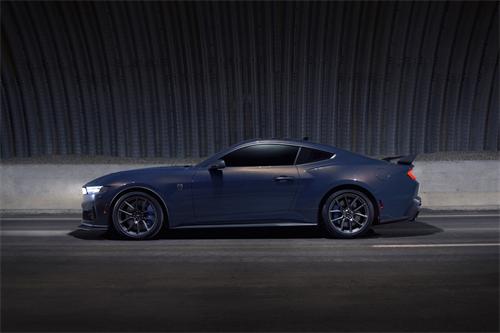
The first roar of the 5.0-liter V8 under the hood when starting the car cold still turns heads in my quiet Orange County neighborhood. Here I am, the guy “taking his race car out for coffee.” But that’s exactly the question I want to explore today: this track-focused American muscle car with the Dark Horse badge—how does it handle the mundanity of daily driving alongside the thrill of open-road cruising? Can it find its rhythm not only at Laguna Seca but also during rush hour on the 405 Freeway?
1. Beast Profile: Overview of the 2025 Ford Mustang Dark Horse
Before diving into my 1,000-mile journey, let’s establish a technical profile for this “Dark Horse.” It’s not an ordinary Mustang GT; rather, it’s a strategic creation from the Ford Performance team positioned between the GT and GTD—a factory-ready track tool with a touch of aftermarket flair.
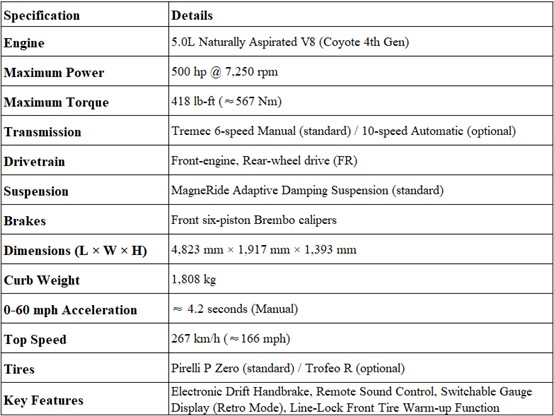
Behind these cold numbers lies Ford’s modern interpretation of the “pony car” bloodline. Unlike the Dodge Challenger, which emphasizes raw straight-line power, or the Chevrolet Camaro, which often plays the value card, the Dark Horse has a clear mission: retain the soul of an American V8 while using a Tremec manual transmission and MagneRide suspension to tackle corners that used to belong only to European sports cars.
2. First 1,000 Miles: From Congested L.A. Streets to Winding Pacific Coast Roads
2.1 City Driving: Dancing With a Beast in Rush Hour
Fuel Economy & Temperature
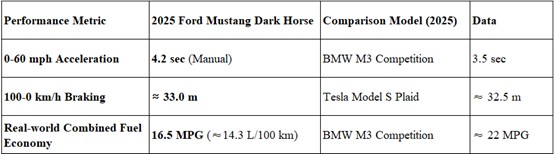
My commute stretches from Irvine to Santa Monica via the CA-73 toll road—a typical Southern California mix of stop-and-go and flowing traffic. The first number that made me wince: pure city fuel economy hovers around 14 mpg (≈16.8 L/100 km). Overall, during my 1,000-mile journey, I averaged roughly 16.5 mpg. Every visit to the Shell 97-octane pump, spending $50 for less than 200 miles of range, is a small financial sting. As Richard Hammond joked in his DRIVETRIBE review: “It’s always been notoriously thirsty.”
Comfort & Noise
Many worry that the MagneRide adaptive suspension will shatter your spine in Track mode. In Standard mode, however, it shows remarkable compliance. Hitting the uneven, worn asphalt of Los Angeles streets, the suspension soaks up bumps cleanly without excess rebound. The real adjustment comes from the optional Pirelli Trofeo RS tires. As SlashGear noted, these semi-slicks aggressively follow seams and grooves in the pavement at highway speeds, demanding both hands firmly on the wheel. Any lapse in attention can make the car twitch—what enthusiasts call “tramlining”—a compromise of track focus over everyday comfort.
Steering & Brakes
At low speeds, the heavy steering gives your biceps a workout. Once moving, the precision is astonishing. The Brembo brakes provide strong stopping power right from the initial pedal press. In complex road conditions, one Beijing reviewer noted that this setup gives immense confidence, proving that “technology changes everything.”
2.2 Highway & Long-Distance Driving: Cruising Across California
Stability & Cruise Comfort
To test long-distance capability, I planned a round trip from Los Angeles to San Diego along Interstate 5. Once speeds exceed 65 mph (~105 km/h), the Dark Horse seems to awaken. The car sticks firmly to the road, and the wedge-shaped rear spoiler generates noticeable downforce. Wind noise exists but is modest, and the V8 at sub-3,000 rpm cruising remains surprisingly restrained. In contrast, the Trofeo RS tires dominate the soundscape with noticeable road noise.
Driver Assistance
Ford’s Co-Pilot360 suite is functional but not revolutionary. Adaptive cruise maintains linear acceleration and braking, but sudden lane intrusions from other cars feel slightly abrupt. Lane-keeping works well on gentle curves, avoiding the side-to-side weaving some other systems display. Honestly, during long stretches, I found myself preferring to switch off these aids and simply enjoy the V8’s low growl—it feels like the car’s natural state.
2.3 Track/Extreme Performance: Malibu Canyon Testing
Though I didn’t hit a track, Malibu Canyon’s serpentine roads provide an excellent substitute.
Acceleration & Cornering
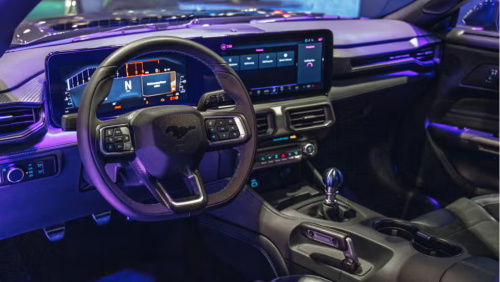
Turning the drive mode knob to Track instantly transforms the digital cluster into a battle-ready interface, even echoing the 1968 retro Mustang theme. The Coyote V8’s high-rev power is mesmerizing: beyond 5,000 rpm, it feels like a kick in the back, delivering linear thrust unlike the sudden surge of turbocharged cars. The Tremec manual gearbox is crisp with short throws and works seamlessly with the rev-matching feature, allowing even amateur drivers to corner like pros.
Compared to the previous Mach 1, the Dark Horse feels more planted mid-corner. FordMuscle tests show that while Mach 1 can feel “sharper” entering corners, the Dark Horse exits faster, demonstrating superior chassis tuning. The Torsen limited-slip differential locks rear-wheel power effectively. The tail flutters at full throttle, but electronic aids intervene subtly, keeping you from the edge of oversteer.
Braking
Heavy braking from high-speed approaches into hairpins is fearsome yet manageable. Even after repeated hard runs, Brembo calipers show minimal fade, proving their track readiness.
2.4 Daily Convenience: Storage, Space, and Tech
Rear Seats & Cargo
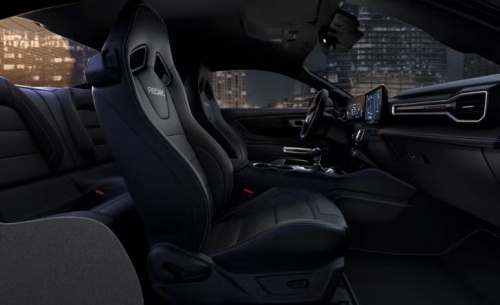
Frankly, the rear seats are decorative. At 5’10” (1.78 m), with my driving position set, the back row barely fits an adult. Ford cleverly turns it into a generous storage area, and the 13.5 cubic feet (~382 liters) trunk easily accommodates a Costco run.
Infotainment & Parking
The 13.2-inch SYNC 4 touchscreen is responsive, and wireless CarPlay works without a hitch. My main headache? The prominent front lip. As SlashGear noted, it scrapes on any ramped parking structure. Over 1,000 miles, I learned to approach ramps almost vertically to avoid damaging this expensive carbon-fiber piece.
3. Comparison Ring: American Glory vs. Electric Future
In this segment of the market, the Dark Horse faces a shifting field. The Chevrolet Camaro has exited the scene, the Dodge Challenger is about to go electric. I chose two representative rivals: the Mustang Mach 1 and Germany’s benchmark BMW M3, adding the Tesla Model S Plaid as an electric-era reference.
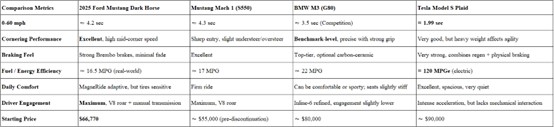
The Dark Horse stands apart in engagement and emotional appeal. It’s faster than the Mach 1 but wilder than the M3. Compared to the Plaid, they’re from two eras: one is the symphony of mechanics, the other the lightning strike of the digital age.
4. Who Should Own the Dark Horse?
Pros
- Unmatched driving ritual: Every start, shift, and high-rev is a sensory celebration.
- Chassis leap: Proves an American muscle car can take on European corners.
- Tech integration: Retro-inspired digital dash blends nostalgia with modern convenience.
Cons
- Daily compromises: Trofeo RS tires’ tramlining, low front lip, and fuel costs demand tolerance.
- Rear seats nearly useless: Strict 2+2 seating.
- Long-distance comfort limited: Suspension is good, but road noise and cabin size constrain touring comfort.
Ideal Owners
The Dark Horse is for those who see driving as a hobby, not mere transport:
- Track-day enthusiasts: Factory-ready for the circuit.
- V8 collectors: In the EV era, this is a mechanical “finale” worth owning.
- Secondary weekend car: If you already own an SUV, this becomes the ultimate joy-bringer.
It’s not ideal as a sole daily driver unless you relish every cautious parking maneuver and accept high fuel bills.
Additional Info
FAQ
Q: Is “Dark Horse” mode suitable for daily driving?
A: There is no singular “Dark Horse mode.” Driving mode selection (Standard, Sport, Track, Wet) changes the car’s character. Standard mode works well for daily commuting, with comfortable suspension and gentle throttle response. The main caveat: the sensitive tires and low front lip require care.
Q: Is long-distance driving exhausting?
A: Yes, but not for reasons you might expect. The Recaro seats are supportive. The real fatigue comes from constant focus: the tires react strongly to road surface changes, limiting casual one-hand cruising; the large body and limited visibility demand awareness in traffic. This “tiring” aspect is part of the driving pleasure.
Author Info & Testing Disclaimer
This article is based on 1,000 miles of real-world daily driving in Southern California, including congested city streets (Los Angeles, Irvine), highway cruising (I-5), and mountain roads (Malibu Canyon). The tested vehicle is a 2025 Ford Mustang Dark Horse Premium, with a Tremec 6-speed manual and optional Dark Horse appearance package. The car was provided by the Ford media fleet for a two-week test period. All opinions are the author’s own and not influenced by third parties.
References: Official Ford specifications, FordMuscle track comparisons, SlashGear in-depth review, ams Driving Tests comparison, and DRIVETRIBE review data. Fuel consumption reflects the author’s actual results and may vary with driving style and conditions.
Recommended for you