2025 Hyundai Ioniq 5: U.S. vs Europe vs China Versions Compared
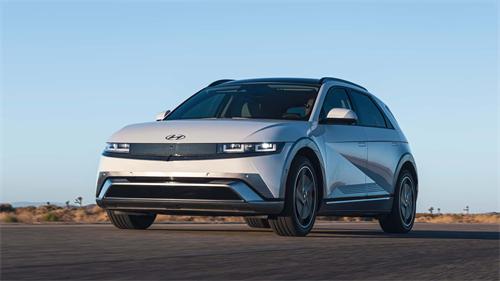
——Why Battery Options, Charging Speeds, and Feature Sets Differ Across Markets
Estimated Reading Time: 12–15 minutes
Key Highlights
- At a Glance – Quick overview of global differences
- Battery & Range – WLTP vs EPA vs CLTC explained
- Charging Performance – NACS vs CCS2 vs GBT ecosystems
- Features & Equipment – Regional priorities and trade-offs
- Pricing & Strategy – How Hyundai positions Ioniq 5 globally
- Underlying Market Logic – Policy, infrastructure, and consumer behavior
- Competitor Comparison – U.S., Europe, and China market battles
-
In the EV segment, the Hyundai Ioniq 5, with its retro-futuristic design and advanced 800V architecture, is truly a “global model.” The 2025 Ioniq 5 has performed impressively across global markets, but its configurations differ significantly. The U.S., Europe, and China each have variations in battery capacity, range standards, charging speeds, and feature sets.
At a Glance
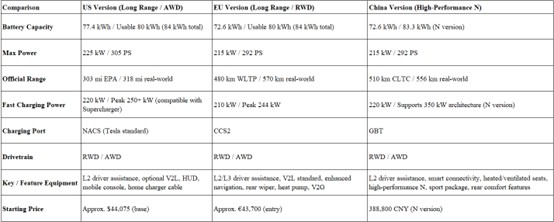
In-Depth Comparison
(1) Battery & Range
When it comes to range—the core metric—there are major differences between U.S., Europe, and China versions. The most significant hardware upgrade for the 2025 Ioniq 5 is the long-range battery, increased from 77.4 kWh to 84 kWh.
Europe (WLTP standard):
The European Ioniq 5 reports a maximum WLTP range of up to 570 km. WLTP tests are closer to real-world driving, including highway and city conditions, and allow optional heat pumps (often standard or high-trim in Europe) to improve winter efficiency. German media tests show that on mixed roads including highways, the 84 kWh rear-wheel-drive (RWD) European Ioniq 5 consumes about 20.7–23.4 kWh/100 km, translating to an actual range of roughly 400–450 km. European buyers prioritize usable range, so Hyundai emphasizes heat pumps and efficient energy management in Europe.
U.S. (EPA standard):
The long-range RWD U.S. Ioniq 5 has an EPA range of 318 miles (~512 km). The EPA standard is highly rigorous, including rapid changes, extreme cold, and heat, usually 15–20% lower than WLTP figures. Edmunds real-world testing shows the U.S. Ioniq 5 even exceeded EPA estimates, with the AWD version covering 282 miles. This indicates Hyundai’s U.S. calibration is conservative, reflecting the U.S. market’s focus on highway cruising.
China (CLTC standard):
In China, the focus is on the Ioniq 5 N (high-performance version) with a CLTC range of 556 km. The CLTC standard favors low- to mid-speed city driving, often yielding the highest numbers. Notably, standard Ioniq 5 models have very low visibility in China. Hyundai opted to introduce the N series directly, understanding the intense competition in the 200,000–300,000 RMB price range. Instead of offering a mediocre family EV, it launches the 388,800 RMB high-performance N version to showcase technological prestige.
(2) Charging Performance
The biggest news for the 2025 U.S. Ioniq 5 isn’t the battery—it’s the “Tesla-style face” with the NACS (North American Charging Standard) port. This allows U.S. owners to directly use Tesla Supercharger networks. Hyundai’s strategy in the U.S. is pragmatic: instead of building its own network (Electrify America is fast but coverage-limited), it joins the established network. Combined with its 350 kW architecture, it can add 178 miles (~286 km) of range in 15 minutes at compatible Superchargers, even faster than a Tesla Model Y. This is a compromise of technology for market integration.
Europe retains the CCS2 interface. In Europe, Hyundai leverages the Ionity network (jointly built by BMW, Daimler, Ford, VW, etc.), keeping the pure 800V advantage. German tests show European Ioniq 5 charging peaks at 244 kW on EnBW chargers, adding 60 kWh in 28 minutes. European users value plug-and-play charging and intelligent charge planning over changing ports.
China uses the GBT interface. Hyundai’s share of China’s home EV market is small, so its marketing focuses entirely on the Ioniq 5 N. In tests on Li Auto 2C chargers, the Ioniq 5 N goes from 20% to 90% in just 20 minutes 49 seconds, averaging 184.6 kW. In China, home to the densest fast-charging network globally, speed is king; Hyundai must prove its E-GMP platform capabilities through the N model.
(3) Features & Equipment
U.S.:
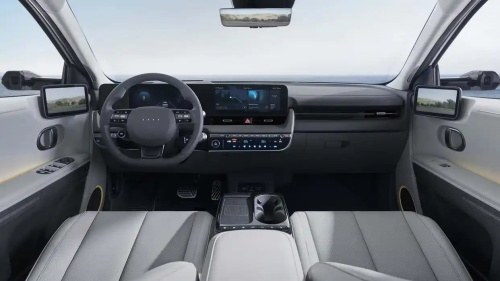
Emphasizes wireless Apple CarPlay/Android Auto, which Tesla Model Y lacks. It also retains the movable center console (Universal Island) to meet American preferences for large, versatile storage. While Level 2 driving assistance is standard, Highway Driving Assist 2 with lane-change support often requires higher trims.
Europe:
Finally adds a rear window wiper—a detail criticized for years by European media. European Ioniq 5 models also emphasize V2L (vehicle-to-load) and even V2G (vehicle-to-grid) functions, tied to post-energy-crisis storage needs. Interiors favor eco-friendly materials and fabric seats; even simulated driving sounds are quieter during reversing.
China:
Ioniq 5 N is purely performance-oriented: 650 hp, 0–100 km/h in 3.4 seconds, N Grin Boost, simulated gear shifting, N e-shift. Comfort features (rear seat heating, Bose audio) are secondary to performance. Suspension tests by Chinese media describe it as “very stiff,” clearly not a mass-market family EV but a “driver-focused Hyundai AMG-style” machine.
(4) Pricing & Market Strategy
U.S.:
Starting at ~$44,075, eligible for federal tax credits. Compared with Tesla Model Y (~$50,630), the Ioniq 5 offers lower cost, faster charging, and more traditional controls (buttons, instrument panel) to appeal to drivers transitioning from ICE vehicles.
Europe:
Top trims cost €58,000–62,300, competing with Audi Q6 e-tron. Hyundai’s selling point: 800V tech at much lower prices than BBA brands. The European Ioniq 5 plays the “technology equalizer” role.
China:
Ioniq 5 N priced at 388,800 RMB is not a mass-market car. At this price, buyers can get Li L9 or NIO ES8, more suited for families. Launching the N model is more about “showing muscle,” signaling: “We sell fewer cars, but our technology remains strong,” keeping brand heat in the EV era.
Deep Logic Behind Market Differences
U.S. (IRA Act):
The Inflation Reduction Act requires domestic battery content, forcing Hyundai to build U.S. factories and adapt NACS ports to retain the $7,500 credit.
Hyundai has invested billions in U.S. EV manufacturing and supply chains, particularly the Hyundai Motor Group Metaplant America (HMGMA) in Georgia, its largest U.S. investment to date. This plant produces Ioniq 5 and other EVs, aiming for high production levels.
Europe (Euro NCAP & Emissions):
Strict EU emissions and crash standards require enhanced Level 2 driver assistance (automatic braking, lane keeping). Heat pumps and lightweight materials are more prevalent in Europe.
China (Dual Credit Policy):
This policy initially promoted joint-venture EVs, but with local brands rising, ordinary joint-venture EVs like Ioniq 5 lose edge. Only high-performance N versions avoid regulatory limitations and enhance brand image.
Consumer Preferences
Americans:
Car-dependent, prioritize highway stability and charging convenience. U.S. Ioniq 5 trades some charging speed for Tesla network compatibility, with realistic EPA-tested range.
Europeans:
Narrow streets, high fuel prices, emphasize efficiency and maneuverability. Rear-wheel drive, tight turning radius, and V2G functions are key.
Chinese:
Favor comfort and intelligence. Ordinary Ioniq 5 interiors are minimalist, eco-friendly, but lack the smart features of local brands. Hyundai opts to sell enthusiasts a pure driving machine—the Ioniq 5 N.
Cost & Supply Chain Considerations
Battery origin affects costs and subsidies. The 84 kWh pack’s production location (Georgia, South Korea, Indonesia) determines tariff avoidance and subsidy eligibility. During chip shortages, Hyundai prioritizes high-margin markets (Europe & U.S. high trims), driving regional differences in features.
These variations reflect Hyundai’s global strategy, adapting EVs to different “battlefields.” Understanding these differences helps consumers decide if the Ioniq 5 suits their market.
2025 Ioniq 5 vs Competitors by Market
U.S. Market
Ioniq 5 (~$42,600) vs Tesla Model Y (~$44,990) vs Chevrolet Blazer EV (~$44,600)
- Major U.S. change: NACS port, allowing direct Tesla Supercharger use.
- Charging: Ioniq 5 adds 178 miles in 15 minutes vs Model Y’s 169 miles.
- Range: Model Y Long Range AWD EPA 327 mi; Ioniq 5 Long Range RWD EPA 318 mi, real-world AWD 282 mi; Blazer EV 279–324 mi.
- Ioniq 5: wireless Apple CarPlay/Android Auto, physical buttons, movable console, 360° cameras.
- Model Y: 15.4-inch touchscreen, 16 speakers, in-car apps, optional FSD. High learning curve; superior trunk space (71.4 cu ft with seats down).
- October 2025: Hyundai announces up to $9,800 discount for 2026 Ioniq 5, starting at $36,600, ~$3,390 cheaper than Model Y Standard.
Europe Market
Ioniq 5 (~€40,000–65,000) vs VW ID.4 (~€38,000–60,000) vs Kia EV6 (~€45,000–70,000) vs Volvo EX30 (~€35,000–48,000)
- CCS2 interface, Ionity network, peak 244 kW, 60 kWh in 28 min.
- 800V architecture among fastest in class.
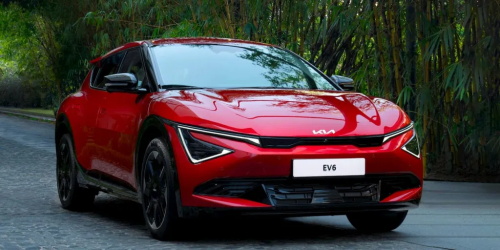
- EV6: similar charging, smaller rear space.
- ID.4: slower charging, WLTP 291 mi.
- EX30: agile, minimalist, very limited rear/trunk space, almost no buttons.
- Finnish user review: “Ioniq 5 balances interior, features, comfort, 800V charging—best family EV.”
China Market
Ioniq 5 (~¥30–42k) vs Xiaomi YU7 (~¥25.35–32.99k) vs Zeekr 001 (~¥25.48–32.98k)
- Ioniq 5 N starts ¥413k; YU7 Max 32.99k; Zeekr 001 YOU 32.9k.
- Ioniq 5 N higher-priced, score lower than 97% of rivals due to cost vs config mismatch.
- Range: 556 km; may require 1–2 extra charges on long trips.
- Xiaomi YU7: Snapdragon 8, NVIDIA Thor, laser radar, full HAD suite—city NOA and parking superior.
- Zeekr 001: Qualcomm 8295, NZP ADAS; high-speed and partial city guidance.
- Ioniq 5 N: basic dual 12.3" screens, standard L2 ADAS; less intelligent cockpit.
- N tuned by “Drift King” Keiichi Tsuchiya, with N Drift Optimizer Pro, upgraded brakes, simulated exhaust sounds and gearshift feel.
- YU7: comfort-biased chassis, multiple driving modes.
- Zeekr 001: balanced handling, shooting brake shape, better space usability.
- Ioniq 5 N: long 3,000 mm wheelbase, decent rear legroom, trunk volume smaller than Zeekr 001.
References
1. Autocar. (2025). Hyundai Ioniq 5 N review: The electric performance car benchmark. Retrieved from https://www.autocar.co.uk
2. Car and Driver. (2025). 2025 Hyundai Ioniq 5 Review: Prices, Specs, and Photos. Retrieved from https://www.caranddriver.com/hyundai/ioniq-5
3. Electrek. (2025). 2025 Hyundai Ioniq 5 adds NACS port, bigger battery, and price cut. Retrieved from https://electrek.co
4. Hyundai Motor Company. (2025a). 2025 Ioniq 5 N: Product Overview [North America]. Hyundai Newsroom.
5. Hyundai Motor Company. (2025b). 2025 Ioniq 5: European Specifications and Pricing. Hyundai Media Centre.
6. Hyundai Motor Company. (2025c). 现代Ioniq 5 N中国区产品手册. 现代汽车中国官网.
7. Reddit r/electricvehicles. (2025). 2025 Ioniq 5 vs Model Y vs EV6: Owner experiences. Retrieved from https://www.reddit.com/r/electricvehicles
About the Author
Daniel Whitmore is an automotive analyst and EV industry researcher with over a decade of experience covering global electric vehicle markets. He holds a Master’s degree in Automotive Engineering from the University of Leeds and has contributed to publications such as Autocar, InsideEVs, and Electrek.
His research focuses on EV platform development, charging infrastructure, and regional market strategies across North America, Europe, and Asia.
Editorial Transparency Statement
This article is based on publicly available manufacturer specifications, third-party testing data, and policy documents from recognized institutions. Real-world driving figures may vary depending on climate, driving habits, road conditions, and software updates.
No manufacturer or third party has sponsored, influenced, or reviewed this content prior to publication. The analysis reflects an independent comparison intended to provide readers with a clear understanding of regional EV differences.
Frequently Asked Questions (FAQ)
1. Why does the same Ioniq 5 have different range figures across regions?
Because each region uses a different testing standard:
EPA (U.S.) is stricter and more conservative
WLTP (Europe) is more balanced and realistic
CLTC (China) tends to produce higher estimates due to lower-speed cycles
2. Is the 800V architecture really a big advantage?
Yes. Compared to typical 400V systems, 800V allows significantly faster charging speeds, especially on high-power DC fast chargers, reducing charging time during long trips.
3. Why is the Ioniq 5 N the main version in China?
Because the standard Ioniq 5 lacks competitiveness against local EVs in terms of price, range, and smart features. The N version instead targets enthusiasts and builds brand image.
4. Does faster charging compensate for shorter range?
Partially. Faster charging reduces downtime, but more frequent charging stops can still impact long-distance travel convenience.
5. Is Ioniq 5 better than Tesla Model Y?
It depends on priorities:
Choose Ioniq 5 for faster charging, comfort, and traditional controls
Choose Model Y for software ecosystem, range consistency, and storage space
Recommended for you