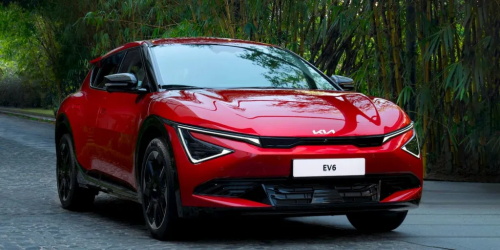
2025 Kia EV6 in the U.S., Europe, and Asia: What’s Really Different?
——Performance, Range, Trim Levels, and Standard Equipment Breakdown
Estimated Reading Time: 10–12 minutes
Key Highlights
- Performance Variations: U.S. comfort vs Europe sportiness vs Asia balance
- Range Ratings Explained: EPA vs WLTP vs NEDC/ARAI differences
- Charging Ecosystems: NACS (U.S.) vs CCS2 (Europe) vs mixed standards (Asia)
- Feature Gaps: Matrix LED, OTA updates, and infotainment differences
- Pricing Strategies: Subsidies, tariffs, and positioning across regions
Just a few years ago, the compact electric SUV market offered limited choices and little excitement. Today, however, it has exploded with impressive contenders—and among the most distinctive and eye-catching is the 2025 Kia EV6.
Since its debut in 2021, the EV6 has built a strong global following thanks to its advanced 800V ultra-fast charging technology and engaging driving dynamics.
As the refreshed 2025 model rolls out across global markets, one thing becomes clear: although it is a “global model,” it is far from globally uniform.
Due to differences in regulations, consumer preferences, charging infrastructure, and even trade policies, the 2025 Kia EV6 presents significantly different characteristics in the U.S., Europe, and Asia.
I. Quick Overview: Same Roots, Different Destinies
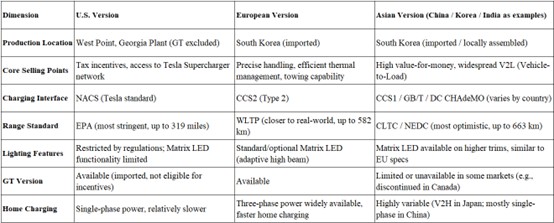
II. Performance and Powertrain
At the mechanical level, the 2025 EV6 maintains a unified global foundation. However, in terms of software tuning and trim strategy, it reveals a split personality.
1. The Unchanged “Core Hardware”
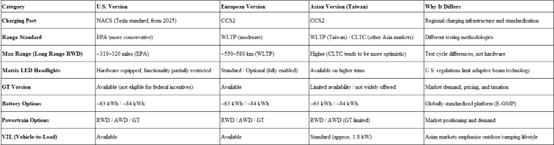
Across all markets, the EV6 is built on the robust E-GMP platform. Battery options are standardized at 63 kWh (Standard Range) and 84 kWh (Long Range). Powertrain configurations remain consistent, including RWD, AWD, and the high-performance GT variant.
2. Key Differences
Tuning Variations
European-spec EV6 models typically feature firmer suspension tuning and heavier steering. This aligns with Europe’s winding rural roads and high-speed highways such as the Autobahn. European drivers tend to prioritize chassis responsiveness and high-speed stability.
In contrast, the U.S. version has been revised with additional sound insulation and softer suspension tuning, delivering a more “plush” ride. This caters to North American preferences for long-distance highway comfort.
Asian versions generally strike a balance between sportiness and comfort, with localized suspension adjustments depending on road conditions.
GT Version Availability
The powerful 601-hp GT variant remains available—but not everywhere. For example, it has been discontinued in Canada for 2025.
In the U.S., the GT is still produced in South Korea and therefore does not qualify for the $7,500 federal tax credit under the Inflation Reduction Act (IRA), which impacts its value proposition.
In parts of Asia, the GT is often seen more as a “halo product” due to its high pricing.
Towing Capacity
The 2025 EV6 sees a notable increase in towing capacity, reaching 2,700 lbs (approximately 1,225 kg) in the U.S.
While European and Asian versions are mechanically capable of similar performance, official ratings and tow hitch availability may vary due to local certification requirements and regulations.
III. Range and Charging
1. Range: Not Directly Comparable
U.S. (EPA)
According to Kia America, the Long Range RWD version offers up to 319 miles (about 513 km). The EPA standard is the strictest globally, incorporating highway driving, extreme weather simulation, and air conditioning usage—making it the most realistic but also the least optimistic.
A New York owner reported a real-world efficiency of 3.1 miles/kWh in summer with a GT-Line AWD, translating to about 260 miles—below the EPA estimate of 270 miles. Winter conditions reduced range by more than 50 miles.
Europe (WLTP)
WLTP better reflects European driving conditions, with more urban cycles. Media figures are typically more optimistic—for example, the 84 kWh version reaches around 582 km.
Asia (CLTC/NEDC/ARAI)
In Taiwan, the older NEDC standard is still used, with figures up to 667 km. In India, the ARAI rating reaches about 663 km.
These numbers are achieved under ideal conditions—no accessories, constant speed, and mild temperatures. In real-world driving, expect about 70–75% of the rated range.
This reflects both regulatory lag and market strategy. Higher official numbers are more attractive in showrooms, even if real-world results differ.
2. Charging Interfaces and Infrastructure
United States: Embracing Tesla’s NACS
The U.S. version adopts the NACS charging port, allowing access to Tesla’s Supercharger network. The port has been relocated to the driver’s side to match Tesla cable layouts.
This enables plug-and-charge functionality (via Tesla’s app) and eliminates the need for adapters.
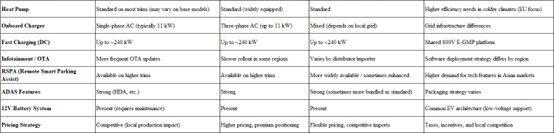
However, most Superchargers operate on 400V systems, limiting charging speeds to around 125–135 kW—slower than the EV6’s potential 240 kW on 800V CCS chargers. Convenience comes at the cost of speed.
Additionally, typical U.S. households use single-phase power, making high-power home charging installations more expensive.
Europe: Staying with CCS2
European models retain the CCS2 standard, supported by a strong third-party charging network such as Ionity.
Many European homes use three-phase power, allowing stable and efficient 11 kW AC home charging with lower infrastructure costs. This supports a “home charging first” ecosystem.
Asia: A Patchwork of Standards
Asia presents the most complex scenario:
- China uses the GB/T standard
- Taiwan follows CCS1/J1772
- Japan emphasizes V2H (Vehicle-to-Home) functionality
The 2025 EV6 increases V2L output to around 12 kW, enabling it to power appliances or even charge another EV. This is particularly attractive in disaster-prone regions like Japan and for camping enthusiasts.
In Southeast Asia, limited public charging infrastructure means users rely heavily on home charging.
A Universal Pain Point: Too Many Apps
Regardless of region, EV6 owners face app fragmentation. One TechRadar editor noted:
“You need apps for Tesla, Electrify America, ChargePoint, EVgo… I have a folder on my phone just for charging.”
Although Kia offers an integrated Charge Pass service, it still lags behind native apps in compatibility and real-time accuracy.
IV. Features and Equipment
1. Lighting Technology
Europe / Asia (High Trims)
European models can be equipped with Matrix LED headlights, which selectively block portions of the high beam to avoid dazzling oncoming traffic while maintaining maximum illumination elsewhere.
United States
Due to FMVSS regulations, these features are often disabled or limited despite hardware availability.
2. Infotainment and OTA Updates
United States
The U.S. version leads with Kia’s latest ccNC infotainment system and more aggressive OTA update strategies, driven by strong monetization of connected services like SiriusXM and in-car Wi-Fi.
Europe
OTA rollout is slower due to GDPR regulations and stricter validation processes. Some users report minimal updates even months after purchase.
Asia
Asian models excel in smartphone integration, with wireless Apple CarPlay and Android Auto often standard, along with localization for regional apps.
3. V2L (Vehicle-to-Load): Standard or Optional?
Asia
Promoted as a key feature, often available even on lower trims, supporting camping and emergency use.
United States
Available but less emphasized, as American users often prefer traditional generators.
Europe
Positioned as part of a green energy ecosystem, especially in combination with home solar systems.
V. Pricing and Market Strategy: Who’s Subsidizing Your EV?
1. United States: IRA Incentives
To qualify for the Inflation Reduction Act, Kia has shifted much of EV6 production to Georgia. Most trims—except GT—are eligible for the $7,500 tax credit.
MSRP (2025):
- Light RWD: $42,900
- Light Long Range RWD: $46,200
- Wind RWD: $50,300
- GT-Line AWD: $58,900
- GT: $63,800
Estimated Transaction Price: $43k – $65k
With Full Tax Credit:
- Light Long Range: ≈ $38,700
- Wind: ≈ $42,800
2. Europe
European models typically start at higher trims, with fewer entry-level options.
Prices reflect import costs and strict emissions regulations, but buyers are willing to pay for better handling, sustainable materials (such as GEONIC fabrics), and advanced lighting technologies.
Price Range:
- Base: €48,000 – €52,000
- GT-Line: €55,000 – €60,000
- GT: €65,000+
Typically 10–25% higher than U.S. pricing.
3. Asia
China
Due to intense domestic competition, imported EV6 models lack price advantage. Instead, they are positioned as niche premium products with fully loaded configurations.
India / Southeast Asia
High import tariffs (70–100%) make the EV6 a luxury product. Typically, only top trims are offered.
Pricing:
- China: ¥280,000 – ¥380,000 (~$39k – $53k)
- India (GT-Line only): ₹60–65 lakh (~$72,000 – $78,000)
1. Kia. (2024a). 2025 Kia EV6: Features and specifications (U.S.). Retrieved from https://www.kia.com/us/en/ev6
2. Kia. (2024b). Kia EV6 model overview (Europe). Retrieved from https://www.kia.com/eu/models/ev6/
3. Kia Motors India. (2024). Kia EV6: Specifications and pricing. Retrieved from https://www.kia.com/in/models/ev6.html
4. Kia Taiwan. (2024). Kia EV6 車型介紹. Retrieved https://www.kia.com/tw/showroom/ev6.html
5. InsideEVs. (2024, October 15). 2025 Kia EV6 first look: NACS port, updated design, more range. Retrieved https://insideevs.com/news/735466/2025-kia-ev6-first-look/
Frequently Asked Question
Why is the GT version unavailable in some markets?
The 2025 EV6 GT has been discontinued in Canada. Officially, this is due to stronger demand for GT-Line variants.
However, underlying reasons likely include limited market size, high certification and parts costs, and reduced demand for high-performance EVs in extremely cold climates.
In the U.S., the GT is not eligible for the $7,500 tax credit, widening the price gap versus other trims and reducing its competitiveness.
Is the GT version worth buying compared to GT-Line?
It depends on priorities. The GT offers significantly higher performance, but lacks tax incentives in the U.S. and comes at a higher price, making GT-Line a better value for most buyers.
About the Author
Daniel Whitmore is an automotive analyst and EV industry researcher with over a decade of experience covering global electric vehicle markets. He holds a Master’s degree in Automotive Engineering from the University of Leeds and has contributed to publications such as Autocar, InsideEVs, and Electrek.
His research focuses on EV platform development, charging infrastructure, and regional market strategies across North America, Europe, and Asia.
Editorial Transparency Statement
This article is based on publicly available manufacturer data, regional regulatory information, and verified user experiences from automotive forums and media reports.
No sponsorship, paid promotion, or manufacturer influence has affected the content. All comparisons and interpretations are made independently to provide objective insights for readers.
Recommended for you