A Weekend Camping Trip With the 2025 Hyundai Santa Fe — What Worked and What Didn’t
Estimated Reading Time: 10–12 minutes
Key Highlights
- Pricing & Trim Strategy: Is it worth $35,000–$50,000?
- Why We Chose the XRT for Camping
- Space & Practicality: A True Family Adventure Vehicle
- Real Camping Experience: What Surprised Us
- Downsides & Known Issues You Should Know
- Which Version Should You Buy?
Honestly, it’s hard to know whether a car is truly “worth it” until you actually take it into real life. This time, with a family of four and an overly energetic pet, we took the 2025 Hyundai Santa Fe out for a weekend camping trip—and that’s when I finally understood what this vehicle is really about. It’s not just a city SUV; it feels more like a mobile living space designed for a growing, active family.
Let’s start with the price. The Santa Fe begins at around $35,000, while the top-spec Calligraphy trim pushes close to $50,000. That’s not a small investment, especially when you’re entering territory where brand prestige starts to matter. So the real question is simple: can the experience justify the cost?
The Santa Fe lineup is surprisingly broad, with nine trims in total—five gasoline models and four hybrids. The gasoline version comes with a 2.5L turbocharged engine paired with an 8-speed dual-clutch transmission, producing 277 horsepower. The hybrid, on the other hand, combines a 1.6L turbo engine with an electric motor for a total system output of 231 horsepower, focusing more on efficiency.
On paper, the hybrid can achieve fuel consumption as low as 5.6L/100 km, though in reality, many owners report that hitting that number requires extremely gentle driving. Even so, compared to the gasoline version’s roughly 10L/100 km, the improvement is significant.
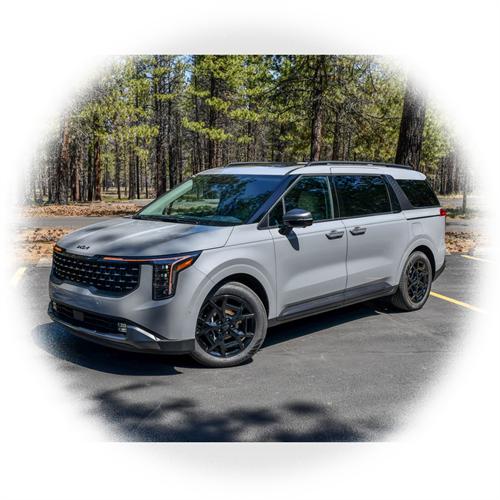
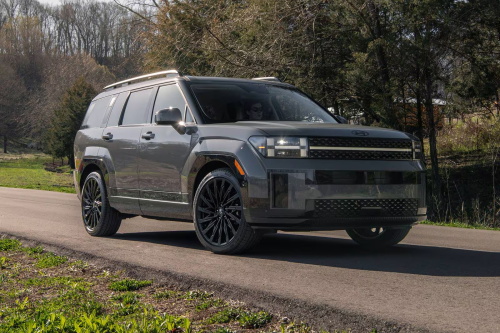
What struck me first about this new-generation Santa Fe is its design. Compared to the previous model’s rounded look, this one has gone fully “boxy.” At first, I wasn’t entirely sold on it. But once you park it at a campsite with gear strapped to the roof, it suddenly makes perfect sense—it looks like it belongs outdoors.
If you’re just using it as a daily driver, the base SE trim is sufficient. But personally, I’d recommend stepping up to the SEL. The price difference mainly shows up in the interior, and that’s where you actually spend your time. Features like H-Tex seats, heated front seats, wireless charging, dual-zone climate control, and—most importantly—a dedicated third-row air vent make a noticeable difference. If you’ve ever sat in a third row without proper ventilation, you’ll know just how essential that last feature is.
For this trip, though, we skipped straight to the XRT—the version that feels purpose-built for camping. It comes standard with HTRAC all-wheel drive, 18-inch all-terrain tires, increased ground clearance, and a blacked-out exterior package that just looks more rugged. More importantly, it offers a maximum towing capacity of 4,500 pounds, which is rare in this class. If you’re thinking about towing a trailer or hauling serious gear, this matters.
Camping rarely involves perfect roads. Gravel, dirt, grass, even sand—those are part of the experience. And in those conditions, the XRT feels reassuring. With about 8.3 inches of ground clearance, improved approach and departure angles, and Continental TerrainContact A/T tires, grip is solid. On gravel roads, the AWD system engages smoothly, and the terrain modes (mud, snow, sand) give you extra confidence—even if some of that is psychological.
That said, after a while, you realize this is still fundamentally a city SUV. Compared to true off-roaders like the Toyota Prado or Ford Everest, it’s in a different league when it comes to suspension travel and extreme terrain capability. Fire trails? No problem. Rock crawling? Probably not a great idea.
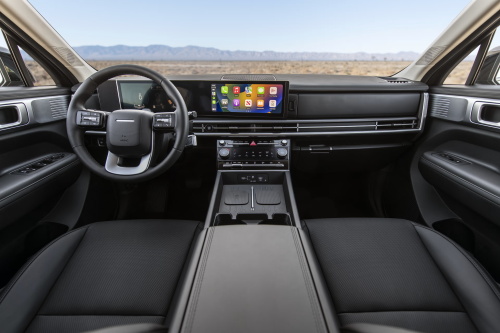
What really impressed me, though, was the space. Once we loaded everyone and everything into the car, the benefits of that boxy design became obvious. The front row is spacious—I’m about 180 cm tall, and headroom was never an issue. The driving position is lower than a traditional off-roader, more like a typical SUV, which actually improves visibility.
The front passenger area also has extra storage spaces, including an open shelf that’s perfect for tossing a bag or small items. It’s a small touch, but it makes daily use easier.
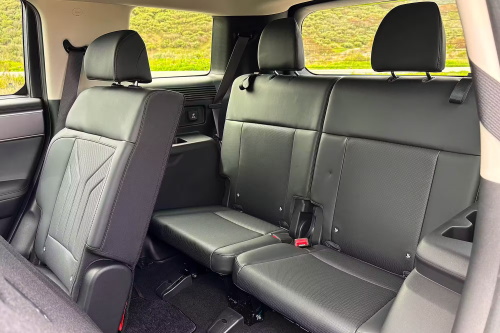
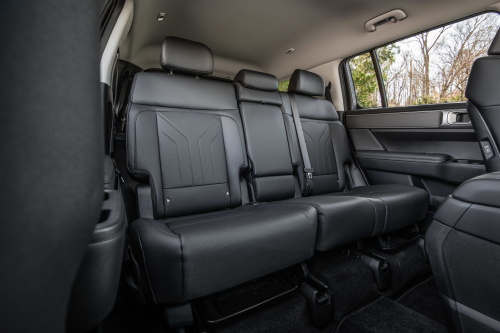
The second row is arguably the best seat in the car. It sits slightly higher than the front, giving kids a better view out. The built-in sunshades are lifesavers in summer, and the heated outboard seats make cold-weather camping much more comfortable.
The third row is more suited for kids or short trips. Adults can fit without headroom issues, but the seat cushion is low and short, so leg comfort isn’t great on longer drives. Still, the attention to detail is impressive—USB-C ports, air vents, fan controls, and cupholders are all there. Unsurprisingly, our kids fought over who got to sit back there, calling it their “secret base.”
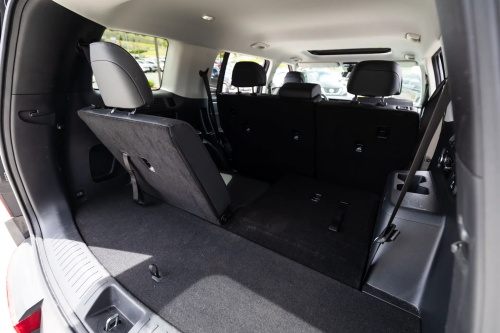
Cargo space is where this car really shines for camping. With the third row folded, you get about 725 liters of space. We managed to fit a four-person tent, three sleeping bags, folding chairs, a camping table, a 40L fridge, storage boxes, and even a scooter. Fold down the second row, and you get a completely flat surface that could realistically double as a sleeping area.
That brings me to a real-world issue: if you plan to sleep in the car and leave the key inside, the vehicle’s systems may not fully shut down. The 12V battery can slowly drain overnight, leaving you with a dead battery in the morning. This isn’t theoretical—it’s something real owners have experienced. Hopefully, a future software update can fix it, because the car is otherwise perfect for car camping.
There are plenty of thoughtful details throughout. The cargo area has a durable plastic surface that’s easy to clean—we wiped off mud and charcoal marks with no problem. There are tie-down hooks on both sides and a 12V outlet, which is perfect for powering camping lights at night.
The UV-C sterilization compartment in the glovebox became a favorite feature—anything from muddy toys to random “treasures” the kids picked up went straight in. The car also offers up to six USB-C ports, which is incredibly practical. The bi-directional center console is another highlight—I can open it from the front while driving, and the passenger can access it from the side.
We also found creative uses for the hooks on the back of the second-row seats—hanging trash bags, wet towels, snack packs—you name it. Even the grab handles on the C-pillar made getting in and out easier.
Of course, it’s not perfect. The all-terrain tires, while capable, do introduce some road noise at highway speeds, even though the laminated front windows help reduce it. The lane-keeping assist works well on highways, but on winding roads or in heavy traffic, it can feel like it’s fighting you for control, which can be frustrating.
There are also some known issues. In the U.S., the 2025 Santa Fe has had several recalls, including problems with the starter motor wiring, engine connecting rod bolts, and rearview camera wiring. Many of these have been addressed in newer production units, but it’s something to be aware of.
Additionally, the 8-speed dual-clutch transmission has received mixed feedback regarding smoothness. Hyundai has stated that software updates have improved it, and the 2026 model is expected to switch to a traditional 8-speed automatic.
If fuel efficiency is your top priority, the hybrid version is definitely worth considering. The front-wheel-drive hybrid can achieve up to 36 mpg (about 6.7L/100 km). Even if real-world figures are slightly higher, it’s still a big improvement over the gasoline model. Considering the hybrid costs only about $1,000 more than the base gasoline version, it’s a compelling option.
In some markets, hybrid models can also be equipped with an XRT-style package. While towing capacity drops to around 1,650 kg, it’s still sufficient for most camping needs. At the same time, you get better fuel economy and a more premium interior, including features like ventilated seats and a Bose sound system, which make long trips more enjoyable.
So here’s my takeaway. If you frequently drive on unpaved roads, need serious towing capability, or simply love that rugged look, the XRT gasoline model is a great fit—it trades a bit of fuel economy for capability, and in this case, that trade feels justified. But if your camping is mostly road-based and you care about long-term running costs, a higher-trim hybrid might be the smarter choice. When you realize how much you save on fuel—enough to fund quite a few barbecue meals on future trips—it becomes a very convincing argument.
References
1. Hyundai Motor America. (2024). 2025 Santa Fe specifications and features. Retrieved from [https://www.hyundaiusa.com](https://www.hyundaiusa.com)
2. National Highway Traffic Safety Administration (NHTSA). (2024–2025). Safety recalls for Hyundai Santa Fe. Retrieved from [https://www.nhtsa.gov]
3. Car and Driver. (2024). 2025 Hyundai Santa Fe review and test results. Retrieved from [https://www.caranddriver.com]
4. Edmunds. (2024). 2025 Hyundai Santa Fe consumer reviews and ratings. Retrieved from [https://www.edmunds.com]
About the Author
Daniel Foster is an automotive journalist and certified vehicle dynamics analyst with over 10 years of experience in road testing, family vehicle evaluation, and outdoor mobility solutions. His work has been featured in multiple North American and European automotive publications, with a focus on real-world usability and long-distance travel performance.
Editorial Transparency Statement
This article is based on a real-world test scenario and independent evaluation. No sponsorship, payment, or editorial control was provided by any automotive manufacturer or third party. All opinions expressed are solely those of the author, based on hands-on experience and publicly available data.
Recommended for you