The Real Reasons Cars Lose Reliability After 100,000 Miles
——Mechanical Wear, Electronics, and the Limits of Modern Engineering
Estimated Reading Time: 10–12 minutes
Key Highlights
- Mechanical wear is no longer linear—modern engines operate closer to their limits
- Turbocharging and direct injection introduce new failure patterns
- Electronics—not engines—are now the most common source of issues
- ADAS systems can degrade without obvious failure signals
- Fuel efficiency and emissions compliance come with hidden durability trade-offs
Why do modern cars seem less durable than the ones we grew up with?
Have you ever had this feeling?
When you were younger, your family’s old Camry or Accord would effortlessly roll past 200,000 miles (320,000 km). Aside from routine maintenance and the occasional strange noise, it just kept going. Back then, “bulletproof reliability” felt almost like a given—especially for Japanese cars.
Fast forward to today. You’re driving a brand-new turbocharged sedan on a smooth highway, and suddenly, the dashboard lights up with a “Check Engine” warning. Your heart skips a beat.
At around 100,000 miles (160,000 km), modern cars seem to reach a psychological turning point.
So what changed?
With engineering advancing at an unprecedented pace, why do cars—arguably more sophisticated than ever—feel less durable? Has reliability actually declined?
As a car enthusiast and a part-time technical observer, I want to break this down from three perspectives: mechanical wear, electronic systems, and engineering philosophy.
Part I: Mechanical Wear — No Longer Linear
For decades, engine wear followed a relatively predictable, linear pattern.
Like a well-made knife, it would dull gradually—but with proper maintenance, it could remain effective for a very long time.
Modern engines, however, no longer follow this pattern. Their wear curve is steeper, often exponential.
Why?
Because modern engines are designed to work harder.
From Low-Stress to High-Stress Design
In the past, most family cars used naturally aspirated engines—inline-4s or V6s ranging from 2.0L to 3.5L. These engines operated under what engineers call a low-stress design philosophy. There was enough displacement to generate power without pushing components to their limits.
Today, things are very different.
Driven by global emissions regulations and fuel economy standards, automakers have embraced downsizing + turbocharging. A 2.0L turbocharged engine is now expected to deliver the same output as a 3.5L V6 from the past.
This introduces several unavoidable physical realities:
- Higher cylinder pressure: Turbochargers force compressed air into the combustion chamber.
- Higher temperatures: More aggressive combustion leads to greater thermal stress.
- Higher operating loads: Engines spend more time in high-RPM or high-load conditions.
A veteran mechanic once put it bluntly:
“Naturally aspirated engines will almost always outlast small turbocharged ones.”
That’s not nostalgia—it’s physics.
When components operate closer to their physical limits, wear doesn’t just increase—it accelerates.
Key Components That Age Faster
1. Turbochargers
Turbochargers are the clearest example of high-stress design. Their shafts spin at over 100,000 RPM under extreme heat. Oil passages can clog due to carbon buildup, especially with extended oil change intervals. What used to be a non-issue in naturally aspirated engines is now a common failure point after 100,000 miles.
2. Timing Chains
Once marketed as “lifetime components,” timing chains are no longer immune to wear. In high-pressure turbo engines, increased load can cause chain stretch and guide wear, leading to noise—or even catastrophic timing failure.
3. Direct Injection Carbon Buildup
Gasoline Direct Injection (GDI) engines have a well-known weakness. Unlike older port-injected engines, fuel no longer washes over intake valves.
As a result:
- Oil vapor and unburned hydrocarbons accumulate on valve surfaces
- Carbon deposits harden over time
- Airflow is restricted, affecting performance and efficiency
In older engines, fuel acted as a natural cleaner. Today, that benefit is gone.
There are real-world examples: a naturally aspirated Honda engine with over 130,000 miles may still have healthy internal components, while many turbocharged GDI engines require costly carbon cleaning much earlier.
Conclusion:
Modern engines are engineered closer to their limits—so once wear begins to accumulate, degradation accelerates significantly.
Part II: Electronics — The New Achilles’ Heel
If mechanical wear can be mitigated with materials and engineering, electronic degradation presents a different kind of challenge.
Modern cars are no longer just machines—they are computers on wheels.
1. Sensor Degradation
Today’s vehicles rely on dozens—sometimes hundreds—of sensors:
- Oxygen sensors
- Crankshaft position sensors
- Tire pressure monitors
- Radar and camera systems for ADAS
These components rarely fail suddenly. Instead, they degrade gradually.
- Oxygen sensors become slower, affecting fuel mixture
- Radar systems lose precision
- Cameras suffer from calibration drift
According to studies from organizations like SAE, semiconductor aging is a real and measurable phenomenon.
2. ECU Complexity and Software Fragility
Modern vehicles contain dozens of Electronic Control Units (ECUs), all communicating via networks like CAN bus systems.
This creates a new category of problems:
- Communication failures: A single faulty module can disrupt the entire system
- Voltage sensitivity: Minor fluctuations can trigger errors
- Software bugs: Increasingly common in modern vehicles
In fact, some reports suggest that up to 40% of issues in advanced vehicles are software-related.
Over-the-air (OTA) updates can fix problems—but they can also introduce new ones.
3. ADAS Calibration Drift — A Hidden Risk
Perhaps the most overlooked issue is the gradual degradation of Advanced Driver Assistance Systems (ADAS).
A 2025 study revealed that even a relatively new vehicle—with just 13,000 miles—showed measurable ADAS performance drift without any collisions or repairs.
Why?
- Road vibrations
- Thermal expansion and contraction
- Minor structural shifts
These factors can cause:
- Cameras to misalign
- Radar angles to shift
- Systems to misinterpret surroundings
The result?
A car that still “works”—but doesn’t see accurately.
This is more dangerous than outright failure.

Part III: The Hidden Trade-Offs of Modern Engineering
Engineers are fully aware of these issues.
But they face competing priorities:
emissions, efficiency, cost, and performance.
Reliability—especially long-term reliability—is only one part of the equation.
Fuel Efficiency vs Durability
To meet strict fuel economy standards, engines operate under:
- Higher compression ratios
- Leaner combustion
While this improves efficiency, it increases:
- Thermal stress
- Component fatigue
- Carbon buildup risks
Lightweighting vs Longevity
Reducing weight improves fuel economy—but often at the cost of durability.
Examples include:
- Plastic water pumps
- Composite intake manifolds
- Rubber-isolated pulleys
These materials degrade faster under heat and stress cycles.
A well-known case involves certain turbocharged engines using rubber-bonded crank pulleys. Over time, the rubber deteriorates—leading to sudden accessory failure.
Extended Maintenance Intervals
Modern vehicles often advertise longer oil change intervals—sometimes up to 10,000 miles.
While synthetic oil can technically last that long, the engine environment may not support it.
Consequences include:
- Oil degradation under high heat
- Increased contaminants
- Accelerated wear on critical components
In short:
The oil may survive—but the engine pays the price.
Part IV: Two Eras, Two Philosophies
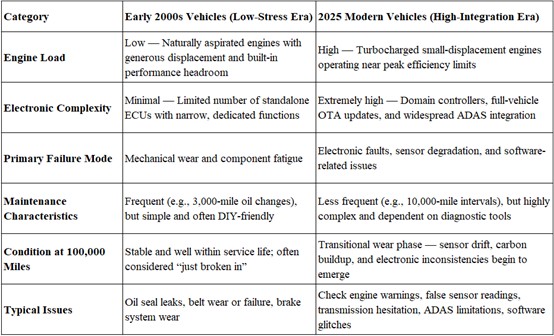
Older cars aged like healthy individuals—slowly and predictably.
Modern cars behave more like high-performance systems operating near their limits.
Part V: Real Owner Experiences
Across forums and repair shops, similar patterns emerge:
- Check Engine Lights become common
Often caused by sensor degradation or carbon buildup—not catastrophic failure.
- Electronic glitches
Adaptive cruise control disengages unexpectedly, or automatic braking behaves inconsistently.
- Transmission behavior changes
CVTs and dual-clutch systems may develop hesitation or roughness due to wear and software adaptation issues.
- Unexpected component failures
Cases like sudden pulley failure highlight how small components can have major consequences.
As one technician put it:
“Modern cars are like middle-aged people—everything still works, but nothing is as stable as before.”
Conclusion: Redefining Reliability
So—have modern cars actually become less reliable?
Not exactly.
They’ve simply been optimized for a different definition of reliability.
In the past, automakers prioritized:
- Mechanical longevity
- Simplicity
- Long-term durability
Today, the focus has shifted toward:
- Emissions compliance
- Fuel efficiency
- Performance
- Short-term ownership experience
Most vehicles are engineered to perform flawlessly within the warranty period—typically 3 years or 36,000 miles.
Beyond that?
Long-term durability becomes less of a priority, especially in markets where average ownership cycles are relatively short.
Final Thought
When your car crosses the 100,000-mile mark and begins to show signs of aging, it’s not necessarily a failure of engineering.
It’s the result of engineering trade-offs.
Modern cars are designed to deliver exceptional performance, efficiency, and technology—within a defined lifecycle.
Longevity, in the traditional sense, is no longer the primary goal.
And perhaps that’s the real shift:
Reliability hasn’t disappeared—it’s simply been redefined.
About the Author
Ethan Walker
Ethan Walker is an independent automotive writer and long-time car enthusiast with over a decade of experience analyzing vehicle reliability trends, ownership data, and engineering design philosophies. While not formally affiliated with an automaker, his work draws heavily on technical literature, industry reports, and real-world repair case studies.
Editorial Transparency Statement
This article is based on a combination of:
- Publicly available industry research and technical papers
- Aggregated owner experiences from automotive forums and repair case studies
- General engineering principles related to thermodynamics, materials science, and system design
The goal is to provide informational and analytical insight, not to promote or criticize any specific manufacturer or model.
All interpretations reflect the author’s independent analysis and are intended to help readers make more informed decisions about vehicle ownership and maintenance.