Why Some Buyers Prefer the Toyota Crown Over Traditional Luxury Sedans
Estimated Reading Time: 12 minutes.
Key Highlights
- How Toyota’s hybrid technology improves reliability and fuel efficiency
- Overview of the 2026 Crown lineup, including the sedan and the Toyota Crown Signia
- Fuel economy, range, and hybrid system efficiency
- Market positioning and key competitors, including the Toyota Camry Hybrid, Honda Accord Hybrid, BMW 5 Series, Audi A6, and Mercedes-Benz E-Class
We are accustomed to our conventional understanding of luxury cars—either a BMW with its driver-focused handling, a Mercedes-Benz packed with cutting-edge technology, or an Audi with avant-garde design. Behind these traits lies a consumer psychology willing to pay for brand prestige, ultimate performance, and exclusivity.
But this logic carries hidden costs. Buying a BMW 530i, for example, can be painful over three years—not just in fuel consumption but also in maintenance bills. Parts are absurdly expensive. For many people, this ownership experience is effectively a hidden financial trap.
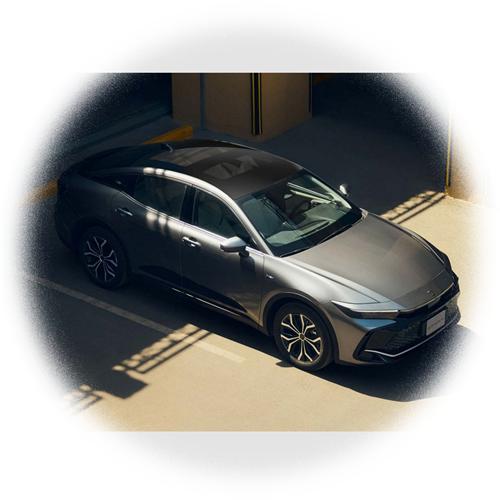
The Toyota Crown fills exactly this overlooked gap—striking a balance between comfort, fuel efficiency, reliability, and maintenance costs.
Elegant Design Inspired by Eastern Aesthetics
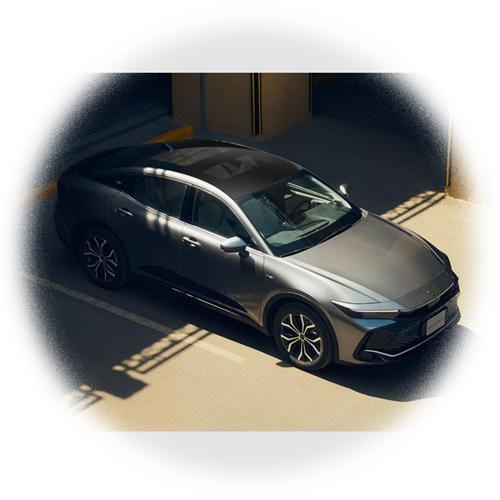
The Crown’s design philosophy has always emphasized elegance and restraint. It does not rely on exaggerated grilles or sharp lines to display status; instead, it conveys a sense of understated sophistication through precise body proportions, exquisite paint finishes, and subtle chrome details.
More importantly, the Crown has always been a “passenger-oriented car.” Seat cushioning, suspension smoothness, and cabin quietness are exceptional, even compared to larger or higher-segment models. Many buyers feel that the “sofa-like” and “floating” sensation offered by the Crown aligns more closely with their understanding of luxury than some high-end brands that sacrifice comfort for sporty handling.
A Rational Choice: Low Fault Rate and Fuel Efficiency
Traditional luxury cars come with high maintenance costs as they age. The Crown, leveraging Toyota’s mature technology—especially its hybrid systems—offers extremely low failure rates and excellent fuel efficiency. For rational buyers who care about long-term ownership costs, the Crown is a clearly safer choice.
The all-new Crown family includes sedans and crossover SUVs with bold, avant-garde designs, appealing to young, high-net-worth individuals seeking style and personality. The Crown feels more premium than Toyota’s mainstream lineup but remains more accessible than traditional luxury brands, striking a balance between rational and emotional value.
The 2026 Crown starts at around $41,440, with the top-of-the-line Platinum version priced at $54,990. At this price, you can enjoy interiors comparable to luxury brands. As Car and Driver puts it: “The Crown delivers a Lexus-like experience, but with a Toyota badge.”
All models come standard with hybrid and all-wheel-drive systems. Whether you choose the 2.5L hybrid for maximum efficiency (236 hp, 41 MPG combined) or the performance-oriented 2.4T Hybrid Max (340 hp, 0-60 mph in 5.1 seconds), the E-Four electronic AWD system is standard across the lineup. This eliminates the need for buyers to compromise between practicality and performance—something hard to achieve in traditional luxury sedans at the same price point.
2026 Toyota Crown at a Glance
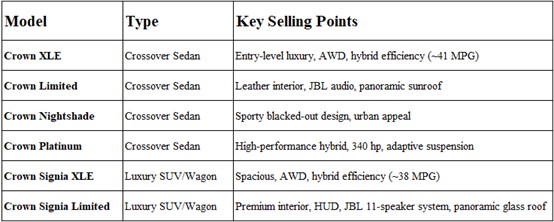
Exterior Dimensions
The Crown sedan and Crown Signia crossover SUV are both nearly 5 meters long, classifying them as full-size vehicles. The sedan measures 196.1 inches long (~4981 mm), 72.4 inches wide (~1839 mm), and 60.6 inches tall (~1539 mm).
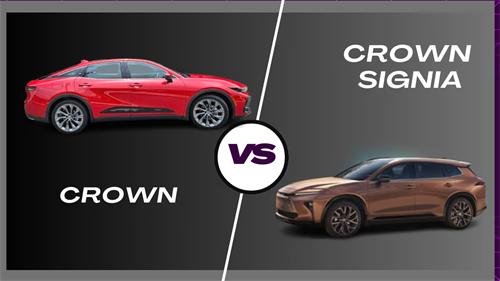
The Crown Signia shares similar length and width but stands taller at approximately 64 inches, offering a higher ride height. Both share the same wheelbase of 112.2 inches (~2849 mm) and the same platform. Ground clearance is 6.7 inches for the Signia versus 5.8 inches for the sedan, giving the SUV better approach and departure capabilities.
Interior Dimensions
Interior space is a key differentiator. The Signia provides about 39.5 inches of front headroom versus 38.2 inches in the sedan. Rear headroom is even more noticeable: the sedan’s sloping roof limits it to 37.5 inches, which can feel cramped for taller passengers, while the Signia’s flat roofline allows 38.5 inches of rear headroom, providing a more open feeling. Rear legroom is roughly equal in both at 38.9 inches.
Driving Experience and Performance
Driving character is where the sedan and Signia diverge the most.
The Crown sedan has a dual personality. The XLE, Limited, and Nightshade trims with the 2.5L hybrid are smooth and comfortable—ideal for urban commuting. The Platinum performance variant with the 2.4T Hybrid Max, however, offers 340 hp and 400 lb-ft of torque, paired with a 6-speed automatic and adaptive suspension, achieving 0-60 mph in 5.1 seconds for a thrilling drive.
The Crown Signia focuses entirely on comfort. It comes exclusively with the 2.5L hybrid (≈240 hp) and an eCVT, reaching 0-60 mph in about 7.1 seconds. Engineers invested heavily in NVH (noise, vibration, harshness) control, making it an exceptionally quiet “mobile palace.” Suspension tuning favors comfort, filtering bumps thoroughly, though body roll is more noticeable under aggressive driving.
Both models come standard with electronic AWD for stability in various road conditions.
Fuel Efficiency
The sedan benefits from lower drag and lighter weight, achieving impressive fuel economy. The 2.5L hybrid version reaches 41 mpg combined (~5.74 L/100 km) with nearly 590 miles (~950 km) range. Even the performance 2.4T hybrid maintains around 30 mpg (~7.84 L/100 km).
The Signia, as an SUV, consumes slightly more at 38 mpg (~6.19 L/100 km) but still excels. Both models have a 14.5-gallon tank, giving the Signia a range of about 550 miles (~885 km).
Interior Comfort and Features
Both models share a similar interior design language, with dual 12.3-inch screens and practical physical buttons. Materials feel solid and luxurious. Signia offers warmer, homey color options like Saddle Tan.
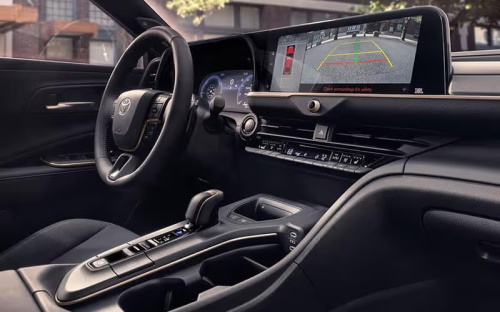
Seats are well-cushioned and supportive. The sedan’s black interior may feel slightly claustrophobic to some. The Signia’s front seats are comfortable but lack additional cushion angle adjustments.
Seat height and visibility differ: the sedan offers a slightly higher seating position than a typical sedan, though not as elevated as an SUV. Signia provides standard SUV visibility with a hip point of 25.8 inches, easing entry and exit.
Cabin quietness favors the Signia, which includes dual-layer front glass and extensive wind/road noise insulation. The sedan is quiet but engine noise is noticeable under hard acceleration.
Technology and Usability
Both models are equipped with Toyota’s latest infotainment and driver-assist systems.
They include 12.3-inch touchscreens, wireless Apple CarPlay and Android Auto, voice control, and 11-speaker JBL audio (high trims). Digital dashboards are 12.3-inch fully digital.
Charging and connectivity: 5 USB-C ports and wireless charging are standard.
Driver assistance: Toyota Safety Sense 3.0 includes pedestrian detection, full-speed adaptive cruise, lane-keeping assist, and optional Advanced Technology Package with 360-degree cameras and front cross-traffic alert.
Cargo and Storage
Cargo is where Signia shines. The sedan offers a standard 15.2 cubic feet trunk. Foldable rear seats provide some flexibility but limited large-item practicality.
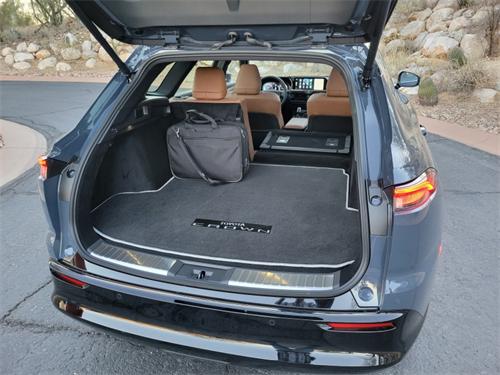
2026 Toyota Crown Signia
Signia starts with 25 cubic feet of cargo and expands to 68 cubic feet (~1925 L) with seats folded, forming a flat floor. It can handle bikes, furniture, or camping gear easily. Interior storage is also more versatile, ideal for families.
Market Positioning and Competitor Analysis
Though sharing brand and technology, the sedan and Signia target distinct segments.
Crown Sedan Competitors
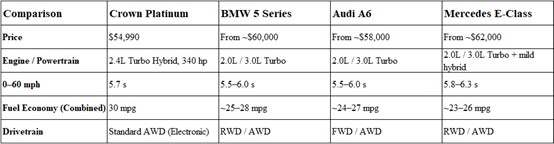
Positioned as a “flagship crossover sedan,” priced $41,440–$54,990. Competitor tiers:
Tier 1: Toyota Camry Hybrid
Direct internal competitor, essential for comparison. Camry starts around $29,000, sells 10x more than Crown, comes standard with 2.5L hybrid (225–232 hp, 0-60 mph ~6.8 sec), top trim 43–44 mpg.
Crown starts at $41,440 (236 hp, 0-60 ~7.1 sec) with Platinum 2.4T hybrid (340 hp, 30 mpg). Camry excels in fuel economy; Crown excels in quietness, premium feel, and 340 hp performance.
Tier 2: Honda Accord Hybrid
Both balance fuel efficiency and practicality in mid-to-large sedans. Accord starts ~$10,000 cheaper, rear headroom slightly better, sportier chassis.
Crown favors comfort and long-distance cruising.
Tier 3: BMW 5 Series, Audi A6, Mercedes E-Class
Crown Platinum performance directly rivals these German luxury sedans but in a different way: lower fuel consumption, Toyota reliability, richer standard features, lower long-term costs. German rivals offer higher brand prestige, better handling, and more luxurious materials.
Crown Signia Competitors
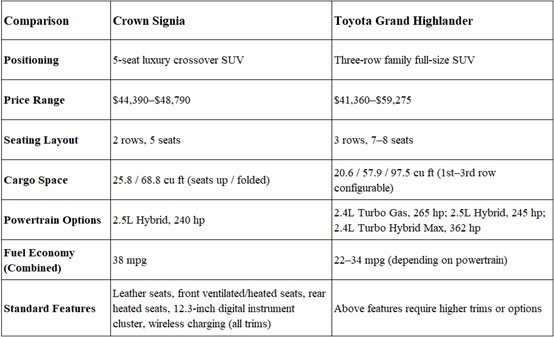
Positioned as a “crossover luxury travel SUV,” starting at $45,985.
Tier 1: Mainstream mid-size crossovers—Honda Passport, Chevrolet Blazer, VW Atlas Cross Sport
Signia is more elegant and refined, with 25.8 cubic feet cargo (68.8 folded), 38 mpg, surpassing conventional fuel-burning rivals (22–25 mpg).
Tier 2: Outdoor-oriented crossovers—Subaru Outback
Outback has decades of outdoor credibility, AWD/X-MODE, 8.7-inch clearance vs. Signia’s 6.7 inches. Signia offers higher fuel economy, premium interior, heated/cooled seats. Choice depends on outdoor capability vs. luxury and efficiency.
Tier 3: European luxury travel wagons—Volvo V90 Cross Country, Audi A6 Allroad
Signia’s styling may be mistaken for a Volvo or Audi. It doesn’t match Audi’s driving dynamics but offers European-inspired aesthetics with Japanese reliability and impressive range (551 miles).
According to January 2026 U.S. full-size vehicle sales, Crown sedan sold 1,073 units in a month, up 67.92% year-on-year. Q4 2025 sales reached 3,620 units, totaling 12,309 for the year.
Notably, the traditional full-size sedan market is shrinking—Chrysler 300 discontinued, Dodge Charger transitioning to EV, Toyota Avalon and Nissan Maxima withdrawn. The Crown has effectively become the U.S. full-size sedan market leader.
About the Author
Alexander Thompson is an automotive journalist and industry analyst with over 12 years of experience reviewing vehicles across North America, Europe, and Asia. He holds an MBA in Automotive Management from the University of Michigan and frequently contributes to MotorTrend, Car and Driver, and other international automotive publications.
References
1. Autoblog. 2026 Toyota Crown Signia first drive review: The stylish SUV that heals Toyota's design fatigue. https://www.autoblog.com/2026-toyota-crown-signia-review
2. Car and Driver. 2026 Toyota Crown Platinum: A Lexus experience with a Toyota badge. https://www.caranddriver.com/toyota/crown/2026-platinum-review
3. Car and Driver. 2026 Toyota Crown Signia: The wagon lovers' choice. https://www.caranddriver.com/toyota/crown-signia/2026-review
4. Environmental Protection Agency (EPA). 2026 Toyota Crown fuel economy data. https://www.fueleconomy.gov/feg/PowerSearch.do?action=noform&path=1&year=2026&make=Toyota&model=Crown
5. Good Car Bad Car. Toyota Crown sales figures – 2026 Q4 and full year report. https://www.goodcarbadcar.net/toyota-crown-sales-figures/
6. Toyota Motor North America. 2026 Toyota Crown: Product information and specifications [Brochure]. https://www.toyota.com/crown/2026/features
7. Toyota Motor North America. 2026 Toyota Crown Signia: Product information and specifications [Brochure]. https://www.toyota.com/crown-signia/2026/features
Editorial Transparency Statement
This article was independently researched and written without sponsorship or influence from any automotive manufacturer. All data, specifications, and opinions reflect publicly available information and professional analysis.
Recommended for you