Should Families Consider the Kia Carnival Instead of a Three-Row SUV?
Estimated Reading Time: 10–12 minutes
Key Highlights
- What makes the Kia Carnival different from traditional MPVs
- Space, entry convenience, and real-world usability comparison
- Cargo flexibility and family-oriented design advantages
- Driving experience, fuel efficiency, and ownership costs
- Carnival vs major competitors (Sienna, GL8, Viloran, Odyssey)
Over the past decade, three-row crossover SUVs have gradually replaced MPVs as the go-to choice for many families. Crossovers are marketed with a stylish, dynamic, and more “SUV-like” image, promising versatility while avoiding some consumers’ preconceived impressions of MPVs. However, beyond design trends and marketing hype, practicality remains paramount, especially for families who need to balance daily commuting, school drop-offs and pick-ups, road trips, cargo transport, and long-term ownership costs. From a purely user-experience perspective, MPVs still outperform most three-row SUVs in several key areas.
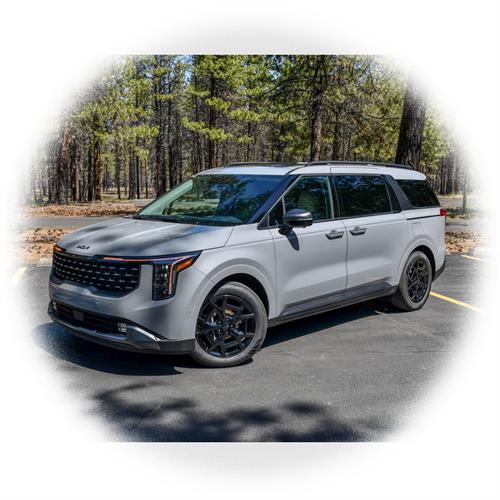
The Kia Carnival is far from a newcomer in the market. In its home country of South Korea, the 2024 hybrid version accounts for over half of its sales, consistently ranking among the top three, outperforming popular SUVs like the Sorento. In North America, automotive media have praised it as “redefining the driving pleasure of MPVs,” with chassis tuning that surprises many and driving dynamics comparable to sport-oriented SUVs like the Subaru Forester, completely breaking the stereotype of bulky MPVs. The Carnival comes standard with Level 2 intelligent driver assistance systems (including full-speed adaptive cruise control and lane-centering), dual power sliding doors, a power tailgate, and heated front seats. Its dual 12.3-inch curved screens feature the Kia Connect system, supporting OTA updates and voice control, providing convenience and comfort for family travel.
Beyond technology and features, space and fuel efficiency are core concerns for families. Compared to three-row SUVs, the Carnival has clear advantages. MPVs are engineered not for fashion but to solve practical problems. It is this utilitarian design philosophy that allows MPVs to excel in areas where three-row SUVs often fall short.
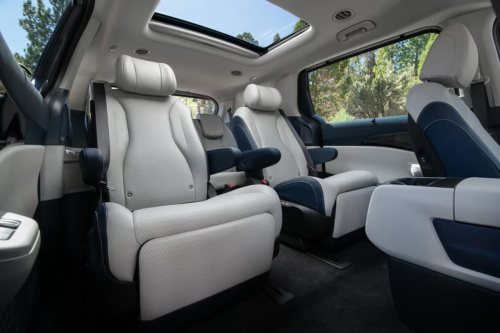
The Kia Carnival, with a 3,090 mm wheelbase, offers generous interior space, particularly in the third row, which breaks industry norms: independent sunshades, large windows, and even a dedicated sunroof make the rear seats comfortable for adults on long trips. Designers also integrated multiple cup holders into the third-row door panels, showing attention to family needs often overlooked by competitors. The wide middle aisle in the second row allows elderly passengers and children to access the third row easily and gracefully. Electric sliding doors further enhance convenience, allowing safe entry and exit in tight parking spaces. A low step-in height, nearly flush with most curbs, makes it easier for children and elderly passengers to get in and out. These upgrades enhance the daily driving experience without compromising practicality.
By contrast, most three-row SUVs feature third rows suitable only for occasional use, with limited long-distance comfort. Accessing the third row typically requires folding the second-row seats, a cumbersome process. The higher ground clearance also makes entry and exit more difficult, especially for elderly passengers and children.
The Carnival features a “deep-dive trunk” design—its third-row seats fold completely into the floor, instantly freeing up 1,793 liters of flat cargo space, making it effortless to transport strollers, camping gear, or luggage. Even with seven passengers on board, the lowered cargo area still provides substantial space for everyone’s luggage.
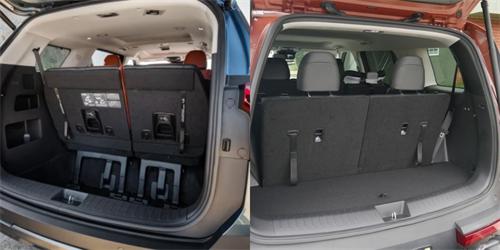
In comparison, three-row SUVs generally leave little trunk space when the third row is in use. Although folding the seats creates more space, it rarely results in a perfectly flat floor, and the process is more complicated.
Driving Experience and Ownership Costs
The Carnival offers tight chassis tuning, excellent visibility, and driving dynamics that defy the traditional perception of “large, cumbersome” MPVs. Its front MacPherson strut and rear multi-link independent suspension have been specially tuned to filter bumps while providing sufficient support, and it handles high-speed cornering better than many competitors.
The 2.0T gasoline engine can run on regular 92-octane fuel, with a combined fuel consumption of approximately 9–13 L/100 km. The hybrid version uses a 1.6T engine paired with a 54 kW electric motor, delivering 245 horsepower and mated to a 6-speed automatic transmission. Its 0–100 km/h acceleration is 8.9 seconds, sufficient for everyday overtaking, while achieving a fuel economy of just 7.2 L/100 km—more efficient than comparable 2.0T gasoline models. However, under hard acceleration, engine noise is noticeable, especially during high-speed overtaking.
Three-row SUVs, on the other hand, offer diverse powertrain options, including gasoline, hybrid, and fully electric versions. When fully loaded, performance may feel strained, and fuel consumption varies widely. Large gasoline SUVs typically consume more fuel, while hybrid or electric models come with higher purchase and maintenance costs.
Key Drawbacks
The Carnival does not offer all-wheel drive, which may limit traction on icy or lightly unpaved roads. Its resale value is lower than competitors such as the Toyota Sienna or Buick GL8, and at highway speeds, wind and engine noise are more noticeable.
Three-row SUVs are inherently constrained in interior space. Regardless of design optimizations, their third-row seating and cargo capacity rarely match an MPV of similar dimensions. Their higher ground clearance also makes entry and exit less convenient, particularly for children and elderly passengers.
Carnival vs. Key Competitors
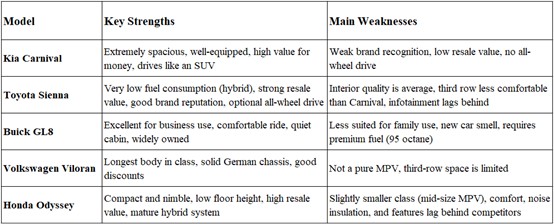
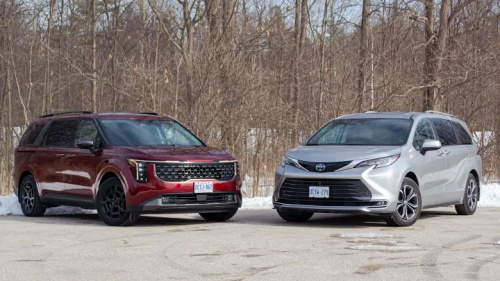
Carnival vs. Toyota Sienna: The Carnival excels in third-row comfort, with independent sunshades and sunroof providing a more open view. Even when fully loaded, its cargo space is among the largest in its class. Its chassis feels solid and engaging, while the Sienna drives like a typical large vehicle—comfortable but less exciting. Carnival offers more upscale features at a similar price, including ventilated front seats, heated/cooled second-row seats, paddle shifters, and roof rails. Sienna, however, benefits from ultra-low hybrid fuel consumption (WLTC 5.77 L/100 km), high resale value, and an available all-wheel-drive option. For families prioritizing passenger comfort and premium features, Carnival is ideal; for those focusing on fuel economy, resale value, or snowy road performance, the Sienna holds an edge.
Carnival vs. Volkswagen Viloran: The Viloran exceeds 5.3 meters in length, presenting a long and grand appearance. However, its third-row space and headroom are not as generous as the Carnival, limiting MPV efficiency. Volkswagen’s German-tuned chassis ensures highway stability, while the Carnival feels lighter and more nimble. The Carnival offers richer base features, whereas the Viloran’s entry-level trim is relatively basic. The Viloran is suited for those drawn to its design and driving feel with occasional third-row use, but for maximum MPV space utility, Carnival is superior.
Carnival vs. Honda Odyssey: The Odyssey’s compact body and low floor provide exceptional entry and exit convenience. However, in terms of overall dimensions, wheelbase (Carnival 3,090 mm vs. Odyssey 2,900 mm), third-row comfort, cargo space, cabin quietness, and suspension performance, Carnival leads comprehensively. The 2.0T + 8AT powertrain delivers strong acceleration, while modern features surpass the Odyssey’s older hybrid system and outdated configurations. For daily urban driving with 3–4 passengers, the Odyssey’s compactness is advantageous, but for occasional full occupancy or higher comfort demands, Carnival is the better choice.
Conclusion
For families prioritizing interior space, ease of entry and exit, third-row comfort, and long-term usability, the Kia Carnival remains a practical choice. Many consumers pay a premium for crossovers but receive less usable interior space and fewer family-friendly features. Carnival accommodates multi-generational travel while keeping maintenance costs manageable with a mature powertrain. Its flexible interior and low floor height uniquely benefit children’s access.
As consumer preferences shift from “brand-first” to “value-driven,” Carnival’s global success—monthly sales exceeding 6,000 units in South Korea and comparable North American reputation to the Odyssey—demonstrates its core product strengths. As one veteran automotive reviewer notes: “When the price bubble fades, Carnival’s global pedigree truly reveals its real value.”
For young families primarily driving in cities with occasional road trips, and who value fuel economy and tech features, the Carnival hybrid is an excellent choice. However, those frequently traveling long distances or living in regions with icy roads should compare it with all-wheel-drive alternatives. Ultimately, there is no perfect car, only the one that fits your needs. During test drives, focus on second-row seat comfort, highway noise levels, and third-row seat usability when folded. For family vehicles, practicality and comfort remain the ultimate priorities.
References
1. Kia Corporation. (2024). Kia Carnival specifications and features. Retrieved from [https://www.kia.com]
2. Car and Driver. (2024). 2024 Kia Carnival review, pricing, and specs. Retrieved from [https://www.caranddriver.com]
3. MotorTrend. (2024). 2024 Kia Carnival first test review. Retrieved from [https://www.motortrend.com]
4. Yonhap News Agency. (2024, August 23). Hyundai Motor, Genesis top U.S. new car tech satisfaction survey. Yonhap News Agency. Retrieved March 17, 2026, from https://en.yna.co.kr/view/ACK20240823002200881
5. Brandt, E. (2025, January 30). 2024 Kia Carnival review: Price, cost-to-own, and more. Kelley Blue Book. Retrieved March 17, 2026, from https://www.kbb.com/kia/carnival/2024/
About the Author
Daniel Whitmore, MSc Automotive Engineering
Daniel Whitmore is an automotive analyst and former vehicle dynamics engineer with over 12 years of experience in chassis development and consumer vehicle evaluation. He has contributed to multiple international automotive publications and specializes in family vehicle usability, long-term ownership cost analysis, and mobility trends. His work focuses on bridging engineering insights with real-world consumer needs.
Editorial Transparency Statement
This article is independently written based on publicly available specifications, verified automotive reviews, and comparative analysis. No manufacturer or brand has sponsored, influenced, or reviewed this content prior to publication. All opinions expressed are objective and intended to assist consumers in making informed decisions.
Professional & Educational Disclaimer
This article is intended for informational and educational purposes only. Vehicle specifications, fuel economy figures, and feature availability may vary by market, model year, and trim level. Readers are encouraged to verify details with official manufacturers or authorized dealers before making purchasing decisions.