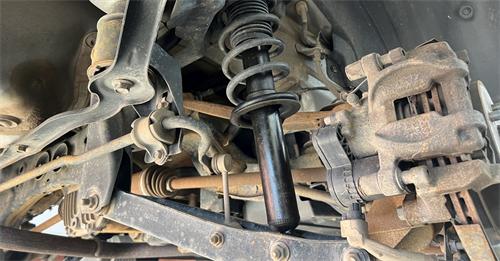
Why Modern Car Engines Fail Earlier Than Expected
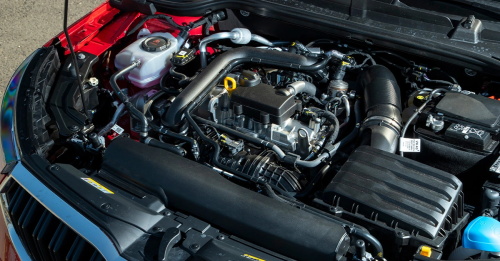
——Understanding Heat, Turbocharging, and Changing Engine Design
Estimated Reading Time: 9–11 minutes
Key Highlights
- Why modern engines may fail earlier than expected
- How heat buildup accelerates engine wear
- The hidden mechanical stress behind turbocharging
- Lightweight materials: efficiency vs. durability trade-offs
- Real-world comparison: naturally aspirated vs. turbo engines
- Practical methods to extend engine lifespan
About two years ago, a friend of mine enthusiastically purchased a popular German 1.5-liter turbocharged SUV. At the time, he told me the car’s power was far superior to his old naturally aspirated vehicle, and the fuel efficiency was significantly better. However, just last week, after barely surpassing 80,000 kilometers, his dashboard started showing warnings, the engine oil consumption skyrocketed as if he were “boiling water,” and there were unusual noises during acceleration. Upon inspection, the result was piston ring seizure and slight cylinder wall scoring, and the repair estimate was nearly half the car’s residual value.
This is not an isolated case. A review of consumer reports and repair data over recent years reveals a concerning trend: modern car engines—especially small-displacement turbocharged engines designed to meet stringent emissions regulations—appear to have shorter lifespans than expected. In the past, a large-displacement naturally aspirated engine running 200,000 kilometers without major repairs was commonplace. Today, many turbocharged engines start showing significant performance decline or mechanical failure after just 80,000–100,000 kilometers.
So what drives this phenomenon? Is it simply the growing pains of technological advancement, or an implicit cost of achieving higher fuel efficiency?
1. The Phenomenon: Shorter Lifespans of Modern Engines
Historically, engine reliability was almost the ultimate benchmark for automotive engineering. Honda earned its reputation for “buy the engine, get the car free” thanks to its naturally aspirated engines, with failure rates as low as 0.29%. Toyota’s naturally aspirated models were considered nearly indestructible, building exceptional brand trust.
However, according to research from European insurer ACE Limited and global repair data, while overall engine failure rates may have decreased, the types and severity of failures are shifting. Small-displacement turbocharged engines show much higher failure rates than their naturally aspirated counterparts. Some 1.5T turbo engines have reported failure rates as high as 10–12%.
Common Failure Patterns:
1. Excessive oil consumption: Many turbocharged engines drop below the minimum oil level even within the 5,000-kilometer service interval.
2. Cylinder sleeve wear and premature piston ring failure: High temperatures cause oil coking, blocking the piston rings, resulting in poor scraping, abnormal compression, and wear.
3. Turbocharger failure: Abnormal noises, oil leaks, and insufficient boost pressure often stem from bearing wear.
All these issues point to a common technical dilemma: to balance performance and fuel economy, modern engines operate under unprecedented high-pressure and high-temperature conditions.
2. Technical Causes: The “Triple Challenge” of Heat, Turbocharging, and Lightweight Design
Why have modern engines become so “fragile”? The core reasons can be summarized into three areas: heat management, the physical nature of turbocharging, and material compromises for weight reduction.
A. Heat Management: The Invisible Killer
If mechanical wear is a “chronic disease” of the engine, uncontrolled heat is the “acute trigger.”
1. The paradox of high thermal load in small-displacement engines
To extract more horsepower, modern small engines often use turbocharging and direct injection. Their power per liter far exceeds that of older engines. For example, a 2.0L naturally aspirated engine may produce 150 horsepower, while a 1.5T turbocharged engine can easily reach 180 horsepower or more. This means more heat is generated in a smaller space.
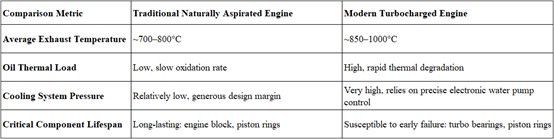
When test-driving performance hatchbacks, I could clearly feel the hood sides becoming almost uncomfortably hot—direct evidence of the increased thermal load. Extremely high exhaust temperatures, sometimes approaching 1,000°C, not only heat the turbocharger but act like a giant space heater for the entire engine bay.
2. High temperatures’ “dimensional attack” on engine oil
Engine oil is the lifeblood of an engine, but it is extremely sensitive to temperature. Studies on oil degradation indicate that as surface temperature rises (up to 236°C), oxidation and thermal breakdown accelerate sharply, forming sludge, varnish, and carbon deposits much faster. In simple terms, high heat exponentially accelerates oil aging. Once oil loses viscosity, its anti-wear properties drop rapidly, leading to piston ring seizure and bearing wear.
3. The stress on thermal cycles
To reduce fuel consumption through rapid warm-up, modern engines employ complex thermal management systems, such as dual thermostats and split cooling circuits. While this improves efficiency, it also places higher demands on water pumps, radiators, and seals. In contrast, traditional naturally aspirated engines experienced more stable, lower thermal loads, with less stress on cooling systems.
B. Turbochargers: The “Spoiled Performance Player”
The turbocharger is the magician of engine performance—but also one of the most delicate components in the engine bay.
1. Dual stress of high compression and high boost
Modern engines often combine high compression ratios with turbocharging to increase efficiency. This can produce staggering cylinder pressures, putting immense mechanical stress on pistons, connecting rods, and crankshaft bearings. If the ECU advances ignition aggressively to extract maximum power, the risk of knock increases, further testing cylinder strength.
2. Bearing “survival limits”
Turbochargers can spin at 120,000–200,000 RPM. Simulations of turbocharger bearings under extreme conditions (e.g., sustained 3,000 RPM) show continuous wear. While theoretically designed to last several years, prolonged high temperatures and high-speed loads accelerate material fatigue, causing increased clearances and seal failures.
3. Cold start and thermal shock
A fatal weakness for turbos is immediately shutting off the engine after high-speed driving. Oil circulation stops, but the turbo housing remains extremely hot, transferring heat to the bearing seat. Residual oil instantly carbonizes, forming abrasive deposits that wear bearings and journals during the next startup. This explains why many racing enthusiasts install turbo timers or insulating blankets.
I once drove a Honda Civic with a modified turbo kit on the track. After a few aggressive laps, opening the hood revealed heat waves visibly distorting the air around the turbo. Without high-quality insulating blankets and heat shielding, nearby brake lines and wiring would have been damaged. Factory solutions are often insufficient due to cost and assembly constraints.
C. Engine Lightweighting: The Cost of Weight Reduction
To meet global fuel economy standards (e.g., CAFE), reducing weight has become mandatory.
1. From cast iron to aluminum alloys
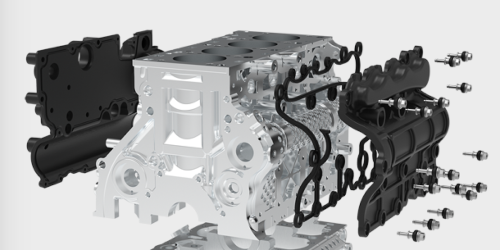
Cast iron blocks were historically unmatched in strength and heat resistance. Today, aluminum alloy blocks dominate to save weight. While modern aluminum technologies are advanced, they cannot fully match cast iron in high-temperature creep resistance and thermal expansion cycles.
For example, Mahindra, in developing its second-generation mHawk diesel, reduced weight by 50 kilograms switching from cast iron to deep-skirt aluminum alloy blocks. However, this requires highly precise thermal management and coatings to compensate for strength differences.
2. Thin walls and integrated designs
Modern blocks feature thinner walls and often integrate exhaust manifolds into the cylinder head. While aiding faster warm-up, these designs concentrate thermal loads, and widely used plastic valve covers or composite oil pans, though lighter, are prone to sealing issues after long-term high-temperature aging.
3. Comparative Analysis: Traditional Large NA Engines vs. Modern Turbo Engines
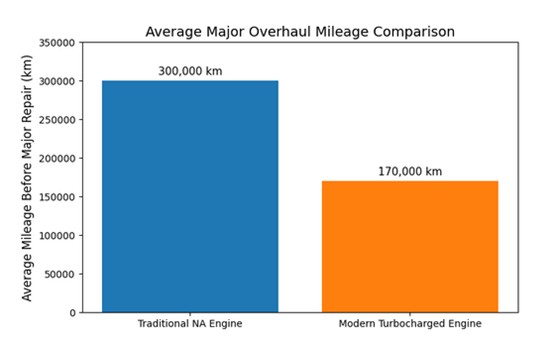
Lifespan:
- Traditional naturally aspirated: Designed with generous margins, operating under relatively mild conditions. Cases of 300,000 km without major repairs are common.
- Modern turbocharged: Operating at the edge of physical limits. Designed lifespan usually targets specific test cycles (e.g., 240,000 km), but in real-world complex driving conditions, core components show a significant increase in failure rate after 150,000 km.
Repair Cost:
- Traditional naturally aspirated: Simple structure, easy to disassemble and repair. Even major repairs are relatively affordable.
- Modern turbocharged: Highly integrated with many peripherals (e.g., electronic water pumps, complex piping). Once the turbo or engine block is damaged, repair costs can easily run into tens of thousands of yuan.
Performance / Fuel Economy:
- Traditional naturally aspirated: Linear power output but higher fuel consumption, with weak low-speed torque.
- Modern turbocharged: Low fuel consumption and high torque are evident in specific conditions (e.g., steady cruising). However, under high temperature and high load, the ECU will actively retard ignition and enrich the fuel mixture to protect the engine, causing fuel consumption to spike and performance to decline.
4. Practical Ways to Extend Modern Engine Life
As an automotive enthusiast and technically minded driver, I’ve compiled several methods to help extend the life of these “delicate hearts.”
1. Upgraded Maintenance: Oil is Key
- Don’t blindly trust OEM oil recommendations: If you frequently drive in city traffic or occasionally drive aggressively, use oil with higher High-Temperature High-Shear (HTHS) values than recommended. For example, if the manufacturer specifies A3/B4, consider C3 grade or higher for stronger high-temperature film strength.
- Shorten oil change intervals: While the manufacturer may specify 10,000 km, for turbo engines, consider 7,500 km or shorter, as oil degradation at high temperatures is irreversible.
2. Driving Habits: Respect Thermal Limits
- Cold start: Avoid immediate aggressive driving. Wait 30 seconds to 1 minute for oil circulation and begin normal driving once the temperature gauge rises.
- Delayed shutdown after high-speed driving: After long highway runs or spirited driving, idle the engine for 1–2 minutes before shutting down. This allows turbo bearings to cool evenly with circulating oil and electronic water pumps (if equipped), preventing thermal soak damage.
3. Hardware Upgrades: Thermal Management
- Turbo insulating blankets: Directly reduces engine bay temperature and protects wiring and hoses.
- Heat shielding for oil and coolant lines: Use high-temperature sleeves for lines near the turbo to prevent premature oil or coolant degradation.
One friend, a seasoned track day driver, used a titanium turbo blanket and exhaust heat wraps on his Civic Type R. Over several years, his engine bay wiring remained pristine, iron content in oil analysis stayed low, and the turbo remained in excellent condition.
5. Conclusion: Embrace Efficiency, Respect Physics
The “premature aging” of modern engines is essentially a recalibration between thermodynamic efficiency and material durability. To meet emissions and fuel-saving goals, engineers have pushed engines to unprecedented high-temperature, high-load states. Aluminum blocks and small turbo engines are not inherently flawed, but they have compressed the engine’s safety margin to the extreme.
As consumers and owners, it’s essential to understand: high efficiency does not equal maintenance-free.
- Owning a small turbo car means committing to precise, potentially expensive maintenance.
- Driving such vehicles requires abandoning old “rough handling” habits, monitoring oil and coolant temperatures, and caring for the turbo.
With the rise of hybrid systems (e.g., dedicated hybrid engines) and the wider adoption of electronic water pumps and precise thermal management, future powertrains may strike a better balance between lifespan and efficiency.
Until then, remember: in that compact yet powerful engine bay, the laws of physics remain supreme. Treat it well, and it will take you further.
FAQ: Frequently Asked Questions
Q1: Do turbocharged engines really have shorter lifespans than naturally aspirated ones?
Statistically, under comparable technological eras, naturally aspirated engines typically last longer due to lower operating temperatures and pressures. Turbocharged engines are not “bad,” but their lifespan depends heavily on maintenance quality and driving conditions.
Q2: Can a failed turbocharger be repaired, or must it be replaced?
Both are possible. Modern turbochargers are highly precise and usually sold as assemblies. Rebuilding (e.g., replacing bearings) requires specialized expertise and balancing equipment and may not be cheaper than replacing the unit.
Q3: Why does my turbo car consume more fuel in winter?
Cold air is denser, and during warm-up, the ECU enriches the fuel mixture to quickly reach operating temperature. Higher oil viscosity at low temperatures also increases internal friction, contributing to higher consumption.
Q4: Can using more expensive fully synthetic oil solve oil consumption issues?
If oil burning is caused by piston ring seizure, high-quality synthetic oil may help clean carbon deposits and alleviate symptoms. However, if caused by valve seal aging or cylinder wall wear, oil changes alone cannot resolve the issue.
References
1. Exoracing. (2025). 3 Essential Upgrades to Protect Your Turbo Setup.
2. Autocar Professional. (2025). Mahindra and Lightweighting: Solid Steel To Nimble Aluminum.
3. SAE International. (2024). Thermal Management Development for a Dedicated Hybrid Engine (Technical Paper 2024-01-2416).
4. ASME. (2025). Temperature Dependence of Aerated Turbine Lubricating Oil Degradation From a Lab-Scale Test Rig (Journal of Engineering for Gas Turbines and Power).
5. Universitas Sumatera Utara. (2025). Analisis Kerusakan Bearing Turbocharger pada Lokomotif Kereta Api CC 201.
6. Aviation Consumer. (2024). Turbo Failures: Heat, Oil, Plumbing.
About the Author
Ethan Walker
Ethan Walker is an automotive enthusiast and independent writer with a strong focus on engine technology, vehicle reliability, and real-world ownership experience. With over a decade of hands-on involvement in car maintenance, track-day driving, and performance modifications, he specializes in translating complex engineering concepts into practical insights for everyday drivers.
Editorial Transparency Statement
This article is based on a combination of publicly available research, industry reports, and real-world ownership experiences. While every effort has been made to ensure accuracy, the content is intended for informational and educational purposes only.
The author does not represent any automotive manufacturer or commercial entity. No sponsorships or financial incentives influenced the opinions expressed in this article.
Frequently Asked Questions
Q1: Are small turbocharged engines inherently unreliable?
A: Not inherently. They are engineered for efficiency and performance, but operate under higher thermal and mechanical stress. Their reliability depends heavily on maintenance quality, oil selection, and driving habits.
Q2: Is frequent oil consumption normal in turbo engines?
A: Mild oil consumption can be normal due to higher operating temperatures and pressures. However, excessive consumption may indicate piston ring issues, turbo seal wear, or PCV system problems and should be inspected.
Q3: Do shorter oil change intervals really make a difference?
A: Yes. Turbocharged engines degrade oil faster due to heat and shear stress. Shortening intervals helps maintain lubrication quality and reduces long-term wear.
Q4: Is idling after a hard drive still necessary in modern cars?
A: Many modern vehicles use electronic water pumps and improved cooling systems, but brief idling (30–90 seconds) after high-load driving can still help reduce thermal stress on the turbocharger.
Q5: Are hybrid engines more durable than turbocharged engines?
A: In many cases, yes. Hybrid engines often operate within narrower, optimized efficiency ranges and experience less stress variation, which can contribute to longer engine life.
Q6: Can engine failures be completely prevented with perfect maintenance?
A: No. While proper maintenance significantly reduces risk, modern engines are designed closer to physical limits. Material fatigue, thermal cycling, and design constraints still play a role over time.