Three New Plug-In Hybrid SUVs for Daily Life: 2025 Mazda CX-60 PHEV vs 2025 Alfa Romeo Tonale PHEV vs 2025 Kia Sportage PHEV
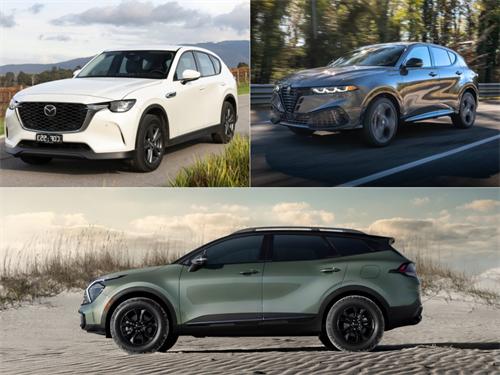
——Electric Range, Fuel Economy, and Driving Character
Estimated Reading Time: 12–15 minutes
Key Highlights
- Chapter 1 – Electric Range: Real-world EV range vs official claims
- Chapter 2 – Fuel Economy: Efficiency when the battery runs out
- Chapter 3 – Driving Character: Three SUVs, three personalities
- Chapter 4 – Pricing & Value: Which one offers the best deal?
- Buying Advice: When a PHEV makes sense—and when it doesn’t
Amid the sweeping electrification of the automotive industry, plug-in hybrid vehicles (PHEVs) are carving out a unique position in the market. In 2025, PHEV sales have surged dramatically—within just the first nine months of the year, global sales in major markets more than doubled compared to the same period in 2024. As a “transitional solution” between traditional internal combustion engines and fully electric vehicles, PHEVs are becoming an increasingly practical choice for many households.
The Japanese-crafted Mazda CX-60 PHEV, the Italian-styled Alfa Romeo Tonale PHEV, and the Korean best-seller Kia Sportage PHEV each represent distinct design philosophies and engineering approaches. From the perspectives of electric range, fuel economy, and driving character, let’s take a deep dive into their real-world daily usability.
Chapter 1: Electric Range — Who Can Truly Deliver “Zero Fuel” Commuting?
For PHEV users, electric-only range is one of the most critical metrics—it directly determines whether your daily commute can truly be achieved without using any fuel.
Mazda CX-60 PHEV: Strong on Paper, Less So in Reality
The Mazda CX-60 PHEV is equipped with a 17.8 kWh lithium-ion battery, with an official electric range of 76 km. This is the highest among the three, even surpassing some small fully electric vehicles. If your daily commute is around 30–40 km, theoretically you could charge just once every two to three days.
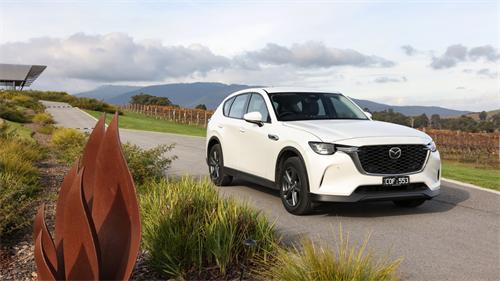
However, real-world conditions are often more complex. Multiple independent tests suggest that the actual electric range is closer to 50–52 km. This discrepancy is not unique to Mazda, but it is worth noting. More importantly, its energy consumption is relatively high—real-world figures range from 23.3 to 24.8 kWh/100 km, which is above average for this class. This means its usable range is affected despite the larger battery.
Charging-wise, using a 7.2 kW home charger, it takes about 90 minutes to go from 20% to 80%. With a standard household outlet (10A), a full charge takes approximately 8.5 hours.
Alfa Romeo Tonale PHEV: A Pragmatic Option
The Tonale PHEV features a 15.5 kWh battery pack, with an official electric range of 43 miles (about 69 km). The more conservative EPA rating in the U.S. is 32–33 miles (about 51–53 km). While lower than Mazda’s official figure, it closely matches the CX-60’s real-world performance.
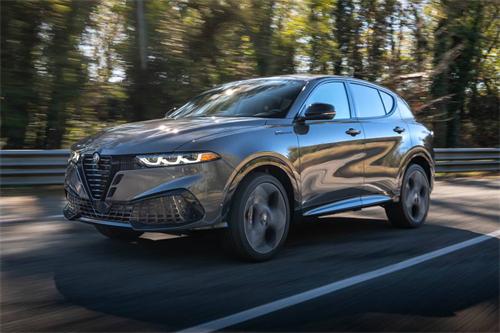
One notable feature is that the Tonale operates as a rear-wheel-drive vehicle in electric mode—the electric motor drives the rear axle, while the 1.3-liter turbocharged engine powers the front. This gives it a rare RWD character among PHEVs.
Charging is the fastest among the three: with a 7.4 kW charger, it takes just 2.5 hours to fully charge—ideal for overnight home charging.
Kia Sportage PHEV: Shorter Range, Faster Charging
The Sportage PHEV has the smallest battery of the three, with an official electric range of 34 miles (about 55 km). This is clearly lower than both Mazda and Alfa Romeo.
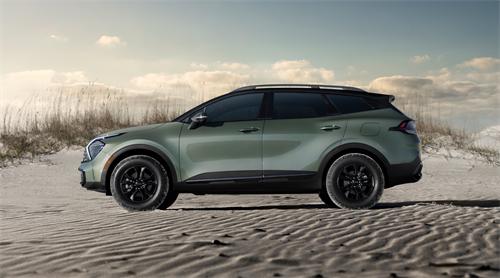
However, it offers the fastest charging speed: using a 240V outlet, it can be fully charged in just 2 hours. While its range is shorter, its quick charging capability may actually be advantageous for users without consistent charging access.
Electric Range Summary
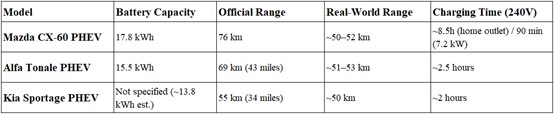
If you’re chasing the longest electric range, Mazda looks best on paper—but in reality, it performs similarly to the Alfa Romeo. The Kia has the shortest range but the fastest charging. In everyday use, all three deliver around 50 km of real electric range—enough for most urban commutes.
Chapter 2: Fuel Economy — Who Performs Best When the Battery Runs Out?
The advantage of a PHEV lies in its dual nature—but once the battery is depleted, it behaves like a conventional hybrid. At that point, fuel efficiency becomes crucial.
Mazda CX-60 PHEV: Concerning Fuel Consumption
Mazda claims a combined fuel consumption of 2.1 L/100 km, which looks impressive—but this is only achievable with frequent charging.
In real-world tests, fuel consumption rises significantly. Mixed driving (starting with a full charge) averages around 3.7 L/100 km, but once the battery is depleted, highway consumption can climb to around 8.5 L/100 km.
This isn’t surprising given its 2.5-liter naturally aspirated engine and a hefty curb weight of 2,195 kg. The combination reduces efficiency in fuel-only mode.
Alfa Romeo Tonale PHEV: Middle of the Road
The Tonale PHEV has an official rating of 29 mpg (about 8.1 L/100 km). While this seems higher than Mazda’s figure, EPA testing is more realistic. Its MPGe rating is 77, still offering advantages over traditional gasoline vehicles.
In practice, its 1.3-liter turbo engine performs steadily at highway speeds, but fuel efficiency gains diminish in long-distance driving. Under heavy load, the powertrain can feel noisy and less refined.
Kia Sportage PHEV: Efficiency Champion
The Sportage PHEV leads in fuel efficiency. Its MPGe rating is 84, higher than Alfa’s 77. When running as a conventional hybrid, it achieves about 35 mpg (6.7 L/100 km).
Its 1.6-liter turbo engine paired with a 6-speed automatic transmission is highly efficient. More importantly, its curb weight (~1,918 kg) is nearly 300 kg lighter than the Mazda, contributing to better overall efficiency.
Fuel Economy Summary
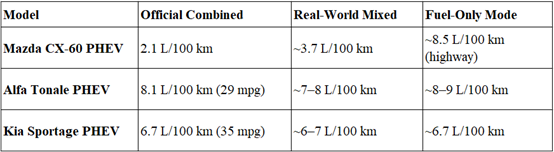
If you frequently drive with a depleted battery, the Kia Sportage PHEV is the most economical. Mazda’s weaker fuel efficiency makes it better suited for users who can charge regularly.
Chapter 3: Driving Character — Three Cars, Three Personalities
If range and efficiency are rational factors, driving feel is entirely subjective. Here, the three vehicles diverge significantly.
Mazda CX-60 PHEV: Refined, but Not Fully Engaging
Mazda is often dubbed the “Japanese BMW,” and the CX-60 carries that expectation. Its combined output of 323 hp and 500 Nm allows a 0–100 km/h time of 5.8 seconds—the quickest of the three.
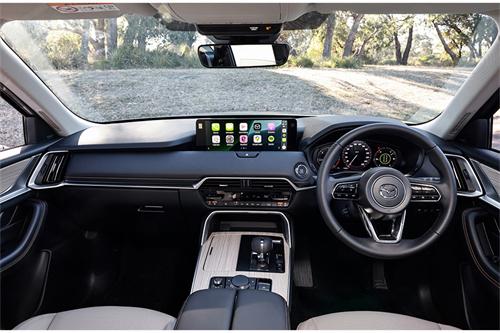
But speed doesn’t equal engagement. Steering feel is light and lacks feedback. Although the 2025 model has improved suspension tuning, it still falls short in sporty driving.
In EV mode, it is smooth and quiet. However, once the engine engages, vibration and noise become noticeable. The transition feels less refined than expected.
That said, interior quality is excellent, rivaling premium brands. For daily comfort and perceived quality, it remains highly competitive.
Alfa Romeo Tonale PHEV: Passion with Compromises
Alfa Romeo stands for driving passion, and the Tonale PHEV tries to deliver. With 285 hp and a 0–60 mph time of 6.2 seconds, performance is respectable.
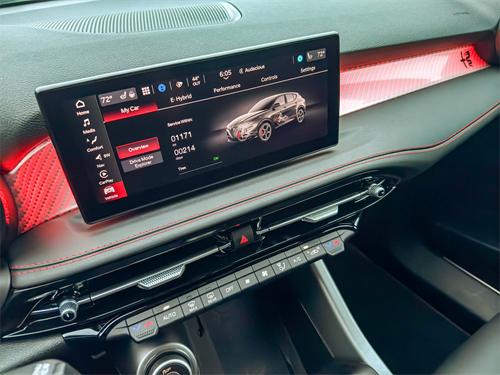
The 2025 update improves power delivery smoothness, but shortcomings remain. Steering is quick but lacks feedback, and braking feel is inconsistent due to poor blending of regenerative and mechanical braking.
Surprisingly, interior space is quite practical, with generous rear seating and cargo capacity.
Kia Sportage PHEV: Rational but Unexciting
The Sportage PHEV is the most practical—and the least exciting. With 261 hp and a ~8-second 0–100 km/h time, performance is adequate but not thrilling.
Its tuning prioritizes comfort and efficiency. Steering is light, suspension is soft, and body roll is noticeable.
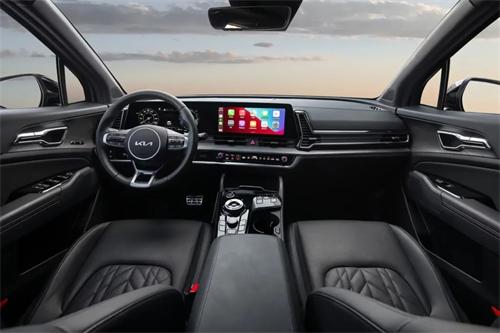
However, it excels in smoothness and refinement. Transitions between EV and hybrid modes are seamless, and cabin noise is minimal.
Interior design is modern and spacious, with class-leading practicality.
Driving Character Summary
Mazda offers the strongest performance, Alfa the most character, and Kia the most usability. For most buyers, Kia’s balance makes it the easiest choice.
Chapter 4: Pricing and Value — Which One Is Worth It?
Mazda CX-60 PHEV: Better Value After Price Cuts
Starting at AUD 63,290, with strong warranty coverage, it offers good value for its quality and performance.
Alfa Romeo Tonale PHEV: Style Comes at a Cost
Starting at $51,995 in the U.S., it’s relatively expensive for its size and performance.
Kia Sportage PHEV: Best Value Overall
Starting at $41,285, with class-leading warranty coverage, it offers unmatched value.
Value Summary
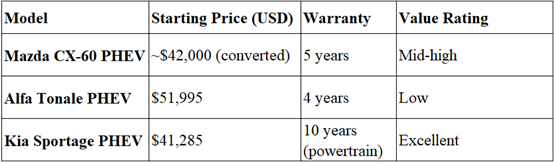
Kia dominates in value. Mazda is competitive after price adjustments, while Alfa is a niche choice.
Final Verdict: Three Cars, Three Lifestyles
Mazda CX-60 PHEV: For Quality-Focused Commuters
Best for users with reliable charging access and a focus on comfort and refinement.
Alfa Romeo Tonale PHEV: For Style Enthusiasts
Best for those who prioritize design and brand identity over value.
Kia Sportage PHEV: The Rational Family Choice
Best for practicality, efficiency, and long-term ownership value.
Final Advice
When choosing a PHEV, your charging situation is critical. Without regular charging, the benefits diminish significantly—making a traditional hybrid a better choice.
If you need more than 80 km of electric range, consider alternatives like the Toyota RAV4 Prime or wait for next-generation PHEVs.
As technology evolves and costs decline, even better options are on the horizon.
References
1. Environmental Protection Agency (EPA). (2024). Fuel economy and electric vehicle range testing data. U.S. Department of Energy. [https://www.fueleconomy.gov]
2. Car and Driver. (2024). 2024 Alfa Romeo Tonale Plug-in Hybrid review and test results. [https://www.caranddriver.com]
3. Motor Trend. (2024). Kia Sportage PHEV review: Efficiency and practicality analysis. [https://www.motortrend.com]
4. Auto Express. (2024). Mazda CX-60 PHEV long-term test review. [https://www.autoexpress.co.uk]
5. Edmunds. (2024). Real-world MPG and EV range testing methodology. [https://www.edmunds.com]
About the Author
Ethan Caldwell
Ethan Caldwell is an automotive journalist and industry analyst with over 12 years of experience reviewing both hybrid and fully electric vehicles, from everyday commuter cars to high-performance sports models. He specializes in real-world testing of acceleration, handling, efficiency, and usability, providing insights that go beyond manufacturer specifications.
His work has appeared in multiple international automotive publications, and he is known for combining technical analysis with hands-on driving experience, making complex automotive data accessible to both enthusiasts and everyday buyers.
Ethan focuses on plug-in hybrids, electric performance sedans, and emerging Chinese EVs, offering comparative reviews that highlight practical ownership insights, driving dynamics, and technology usability.
Editorial Transparency Statement
This article is based on a combination of:
- Manufacturer specifications and officially published data
- Independent third-party testing (media reviews, EPA data, and industry reports)
- Cross-market comparisons (U.S., Europe, and Australia where applicable)
No sponsorship or financial incentives influenced the content of this article. All evaluations aim to reflect real-world usability rather than marketing claims, with particular attention to discrepancies between official figures and actual performance.
While every effort has been made to ensure accuracy, specifications and pricing may vary by region and are subject to change.