I Tested the 2025 Rivian R1S on Dirt Trails and Highways
— A Real Owner’s Perspective
Estimated Reading Time: 12 minutes
Key Highlights
- First Hands-Off Experience on I-5
- Why I Chose the Rivian R1S
- Dirt Trails & - Highway Driving
- Comparison with Competitors
- Real Drawbacks
The first time I took my hands off the steering wheel at 70 mph on Interstate 5 in Los Angeles, I didn’t trust it.
It was a glaringly bright afternoon. I was driving this 2025 Rivian R1S Dual Max along a long, straight stretch of road toward Bakersfield. Traffic wasn’t heavy, but it wasn’t light either. Semi-trucks rumbled along the right lane, kicking up waves of dust. I took a deep breath and pressed the activation button on the right side of the steering wheel. A message flashed on the instrument cluster: “Enhanced Highway Assist activated.”
My hands hovered just above my knees, but my heart was in my throat.
It wasn’t because of the road conditions—it was because this is a full-size, three-row SUV weighing over 7,000 pounds, now driving itself on California’s I-5. The feeling was strange: like handing your child over to a teenager who just got their driver’s license for the first time, or like trusting a stranger to guide you into a dark cave. You can’t help but ask yourself: am I really going to do this?
Why I Chose It
Before diving into this journey, I should introduce myself. I’m not one of those professional reviewers in lab coats carrying testing equipment. I’m just an ordinary father living south of Silicon Valley, in the San Jose area.
My reason for buying the Rivian R1S was actually quite simple: I needed a vehicle that could handle weekday duties—dropping kids off at school, running to Costco—and also satisfy my weekend urge to escape the Bay Area, heading to places like Lake Tahoe or the Mojave Desert for off-road adventures.
This “one vehicle for everything” idea is probably something many people can relate to. I didn’t want two cars sitting in the garage, and I didn’t want to sacrifice daily comfort just for off-road capability.
I used to own a Jeep Wrangler. It was tough, no doubt—but honestly, driving it on Highway 101 felt like wrestling a bull. I also considered the Toyota Land Cruiser. It’s undeniably reliable, but in terms of technology and environmental philosophy, it felt like it was missing something.
Everything changed when I got this second-generation 2025 R1S.
Dirt Trails — No Longer Fighting the Terrain
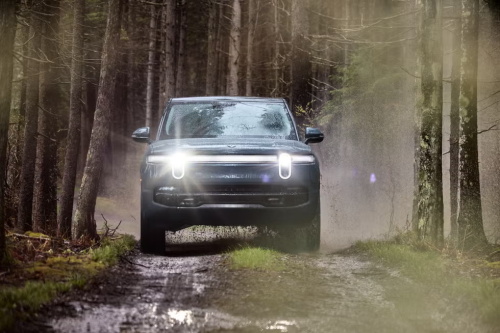
Last weekend, I took it to an unpaved area in the mountains north of Los Angeles. The terrain was a mix of sand, gravel, and ruts carved by rainwater over the past few weeks—perfect conditions to test its off-road capability.
Unlike my old Jeep Wrangler, the R1S doesn’t feel like it’s fighting the terrain. It feels like it’s reading it.
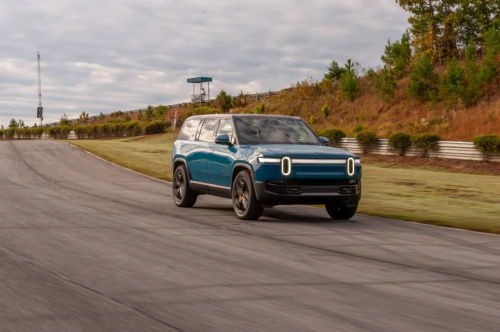
In off-road mode, the air suspension automatically raises the vehicle, offering an impressive maximum ground clearance of 14.9 inches. When entering a dried riverbed filled with cross-axle obstacles, I realized just how different this experience was.
In the Wrangler, I would’ve had to carefully pick my line to avoid lifting a wheel. In the R1S, I just held the steering wheel steady and modulated the throttle.
What surprised me most was how well one-pedal driving works off-road. When climbing a gravel slope, lifting off the accelerator instantly applies negative torque from the motors—far more precise and smoother than traditional engine braking.
There’s no harsh ABS pulsing, no clunky downhill descent control noises. Instead, it feels like an invisible hand is gently pulling this 7,000-pound beast down the slope at a controlled crawl. Inside the cabin, it remains eerily quiet—just the sound of gravel crunching beneath the tires. No roaring engine, no mechanical violence.
It’s a strange sensation. I didn’t feel like I was conquering nature—I felt like I was having a silent conversation with it. The R1S’s intelligent all-wheel-drive system constantly adjusts torque at each wheel in milliseconds, turning me from an operator into more of a decision-maker.
Highway Driving — From Driver to “Supervisor”
If dirt roads are the weekend adrenaline, highways are the daily baseline—and this is where the 2025 R1S has evolved the most.
Thanks to its new second-generation electrical architecture and air suspension, the R1S completely redefines what a “truck-based SUV” feels like on the highway. The previous generation had a slight floatiness on certain surfaces, but now it feels planted and stable.
Cabin quietness is excellent. There’s minimal wind noise and almost no road noise. Even with a roof rack installed, the noise remains within an acceptable range.
But what truly changed my driving habits was the OTA update.
The biggest highlight is the Enhanced Highway Assist system. This goes beyond standard lane-keeping—it’s now closer to a hands-free Level 2 advanced driver assistance system.
During my 500-mile round trip from San Jose to Bakersfield, I experienced the system extensively. It uses a driver monitoring camera to track your eyes—even when wearing sunglasses, it can usually detect your gaze, though it can struggle under certain lighting conditions.
Once it confirms your attention is forward, it allows short periods of hands-free driving, but it frequently reminds you to stay alert.
It also supports automatic lane changes. You simply nudge the turn signal, and the system looks for an opportunity to change lanes. But in real-world use, I noticed it has its own “personality.”
No avoidance behavior near trucks:
This made me the most nervous. When passing an 18-wheeler at 84 mph, the R1S holds perfectly centered in its lane. The display clearly shows it detects the truck, but it doesn’t subtly shift left like a human driver would. If the truck drifts slightly, the gap becomes uncomfortably narrow. I often took over manually to create a bit more space.
Extremely strict driver monitoring:
This is a double-edged sword. It enhances safety, but it can feel overly sensitive. If I glance down at the center screen or check speed—even for a second—it starts warning me. Adjusting something like air vents (which requires navigating menus) basically forces you to put a hand back on the wheel, or the system will keep alerting you.
Weakness with cut-ins and multi-car scenarios:
Like most systems on the market, it reacts slower when the second car ahead brakes. It can “see” that car and even display it, but its acceleration and braking decisions are primarily based on the car directly in front. That means if the lead car brakes suddenly, the R1S brakes later and harder than a human would. My Tesla Model 3 behaves similarly—this is still an area needing improvement.
Despite these flaws, the update is a milestone. On long drives, fatigue is significantly reduced. I’m no longer constantly making micro-adjustments—I can sit back and simply “supervise” the vehicle with my eyes.
Comparison — The Ultimate Crossover Philosophy
After living with the R1S for a while, I’ve come to see it as something truly unique in today’s market. Comparing it with a few typical competitors helps clarify that:
Tesla Model X:
More intelligent. Its FSD Beta makes more confident decisions in complex scenarios. But the Model X falls short in practicality—its third row feels more like an afterthought. Off-road, it’s not even close.
Ford Bronco:
More hardcore. Built for rock crawling. But on paved roads, comfort is nowhere near the R1S. The R1S’s air suspension strikes a near-perfect balance between comfort and control.
Toyota Land Cruiser:
Legendary reliability. It’ll get you out and back. But in terms of interior tech, acceleration, and overall intelligence, it feels like a product from a previous era.
So my conclusion is simple:
The Model X is smarter, the Bronco is tougher, the Land Cruiser is more reliable—but only the R1S feels like a true balance of all three.
It delivers explosive acceleration (the tri-motor version does 0–60 in 2.9 seconds), carries your whole family, tackles off-road terrain, and stays technologically advanced.
Real Drawbacks — The Other Side You Can’t Ignore
Over several months of ownership, I’ve also encountered some frustrating issues.
The March 2025 update introduced hands-free driving—but some users experienced a bug where automatic lane change disappeared, requiring multiple system reboots to fix. It honestly feels like paying $100,000 to beta test software.
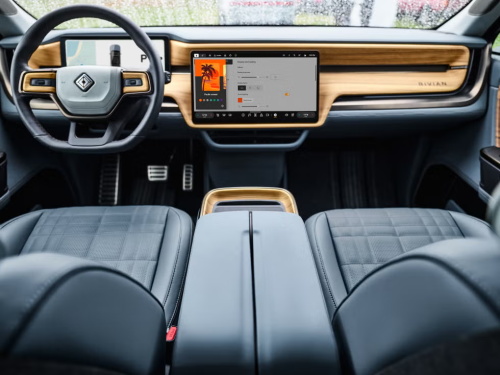
Rivian insists on using its own native system. It’s beautifully designed, responsive, and even powered by Unreal Engine—but the lack of Apple CarPlay is a major downside. You can’t seamlessly use apps like Waze or iMessage on the screen, relying instead on Bluetooth or Alexa.
Charging is improving, but still not seamless. While Rivian can now access Tesla’s Supercharger network via adapters and has its own Adventure Network, the experience isn’t as smooth. At a third-party fast charger in Bakersfield, it took 45 minutes to go from 20% to 80%, costing over $60—more than expected.
And then there’s physics. A 7,000-pound vehicle is still a 7,000-pound vehicle. Even with decent aerodynamics, range drops noticeably in winter or when cruising at 85 mph (the system’s upper limit).
Additionally, discussions about the limitations of driver assistance systems in complex scenarios continue within the user community. While Rivian keeps improving via OTA updates, these features are still evolving.
In the end, the R1S isn’t perfect—but it might be the closest thing I’ve driven to a true “do-it-all” vehicle.
References
1. MotorTrend. (2025, March 12). 2025 Rivian R1S Tri-Motor first test review: Does it deserve the "Max" package?. https://www.motortrend.com/reviews/2025-rivian-r1s-tri-motor-max-package-first-test-review/
2. Rivian Owners Forum. (2025, March 15–April 2). 2025.10.00 software update discussion [Online forum posts]. https://www.rivianownersforum.com/threads/2025-10-00-software-update.12345/
3. Rivian Stories. (2025, March 5). Release notes: 2025.10.00 software update. https://stories.rivian.com/2025-10-00-software-update
About the Author
This article was written by Markus Schneider, a father and everyday driver from San Jose, California. Markus has no formal automotive journalism background but has extensive personal experience testing both daily-use and off-road vehicles. He shares insights from a real-world owner’s perspective, balancing family needs with a passion for adventure driving.
Editorial Transparency Statement
This article reflects the firsthand experience and opinions of the author. All testing was conducted personally by the author on public roads and private off-road trails. No compensation was received from Rivian or any other automotive manufacturer. Any specifications or features mentioned are accurate to the best of the author’s knowledge at the time of writing.