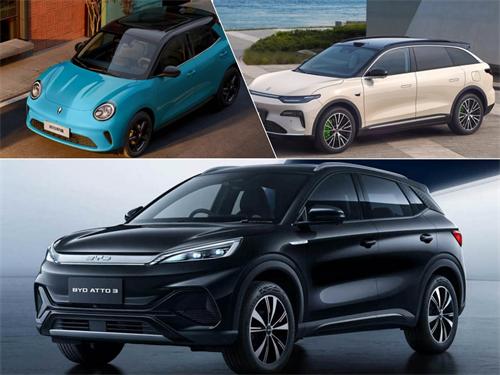
2025 BYD Atto 3 vs 2025 Ora Good Cat vs 2025 Leapmotor C11
——Chinese EV trio on range, tech, and usability
Estimated Reading Time: ~12 minutes
Key Highlights
- Chapter 1: BYD Atto 3 – Balanced Global Compact SUV
- Chapter 2: Ora Good Cat – Stylish Urban Commuter
- Chapter 3: Leapmotor C11 – Tech-Packed Mid-Size SUV
- Side-by-Side Comparison & Buying Advice
Over the past three months, I had the opportunity to test-drive the 2025 models of these three vehicles, covering nearly 2,000 kilometers across Beijing’s Fifth Ring Road, Shanghai’s Inner Ring Road, and intercity highways in Hangzhou. As someone who has long followed China’s new energy vehicle (NEV) industry, I aimed to capture the most authentic character of these three very different models through this comparison.
By 2025, Chinese NEVs have shifted from being “followers” to “trendsetters” on the global stage. Among the dazzling lineup of Chinese EVs, the BYD Atto 3 (known domestically as Yuan Plus), Ora Good Cat, and Leapmotor C11 are three representative models with distinct personalities. They reflect three different product philosophies: BYD’s globalized and steady expansion, Ora’s personalized and stylish approach, and Leapmotor’s tech-packed, value-disruptive strategy.
Chapter 1: BYD Atto 3
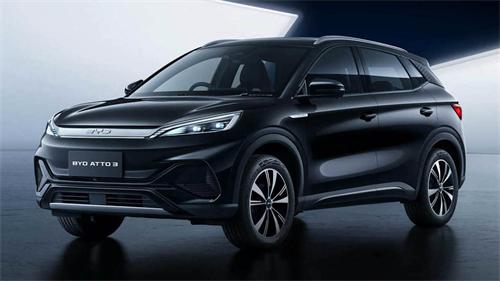
Before I got my hands on the 2025 BYD Atto 3 (Yuan Plus) test drive car, I was somewhat excited—after all, this model has been the sales champion of compact pure electric SUVs in China for two consecutive years. Would BYD pull a big surprise with the 2025 version?
After experiencing it, my conclusion is: this is a typical “incremental update.”
Starting with the powertrain: the car I tested is the Glory Edition with 510 km range, equipped with a front-mounted permanent magnet synchronous motor, delivering 150 kW (204 hp) and 310 N·m peak torque. My real-world 0-100 km/h acceleration was around 7.5 seconds, close to the official 7.3 seconds. While this performance is not outstanding in the 2025 EV market, it benefits from linear output, and the accelerator pedal is tuned to be very controlled—especially noticeable during Beijing’s morning peak traffic, preventing the car from jerking forward due to over-sensitive throttle.
The battery remains BYD’s proud Blade Lithium Iron Phosphate battery, with a capacity of 60.48 kWh. I conducted a range test: starting from Yizhuang in Beijing, I drove round-trip on the Jinghu Expressway to Tianjin, approximately 260 km, including city roads, highways, and minor traffic congestion. The displayed consumption was 14.8 kWh/100 km, with an actual range achievement rate of about 82%. For an SUV weighing over 1.7 tons, this is a decent result.
What truly impressed me was the cabin. The 15.6-inch adaptive rotating floating pad remains the centerpiece of the interior. The DiLink 4.0 system is highly responsive, with fast voice recognition and accurate commands. I tested consecutive instructions—“turn on the air conditioning, navigate to Guomao, play Jay Chou”—and the system executed all successfully. The 2025 model’s new “light luxury beige interior” looks better than the old blue-and-white combination, and the seat cushioning is soft, offering good long-distance comfort.
However, I was somewhat surprised that there were almost no upgrades in intelligent driving. The DiPilot system remains a Level 2 driving assist. ACC adaptive cruise control follows vehicles smoothly on highways, and lane-keeping is steady, but the system hesitates on sharp curves, requiring manual intervention. Compared to other new EV brands at the same price point, Atto 3’s smart driving capabilities are only “adequate.”
What Do Overseas Users Get?
To understand domestic vs. international differences, I compared the 2025 Atto 3 information from BYD’s European, Australian, and Southeast Asian websites and reviewed recent articles from Autocar and CarExpert.
A somewhat surprising finding is that overseas users don’t get the newest design just released in China.
According to BYD Australia’s website, the international 2025 Atto 3 keeps the pre-facelift exterior, with changes mainly including new 18-inch wheel designs and a new all-black interior option—an interesting change since many overseas forum users had complained that the old blue-and-white interior was “too flashy.”
Another notable update is that the international version finally includes front seat ventilation, a feature that has long been standard on high-trim Chinese models. In hot markets like Australia, ventilated seats are almost a necessity.
Additionally, the international version replaces the 12V lead-acid battery with a lithium iron phosphate battery. While seemingly minor, this improves the lifespan and reliability of the low-voltage system and reduces vehicle weight.
However, the core powertrain remains the same as the Chinese version: 150 kW motor paired with a 60.48 kWh battery, WLTP range 420 km (roughly equivalent to 510 km CLTC).
Where Is the Gap?
While I drove the Chinese 2025 Atto 3, my overseas colleagues received what is essentially a “minor facelift from last year.” More importantly, according to China’s MIIT filings, BYD has already registered a “Super Edition” Yuan Plus with 74.88 kWh battery and 308 hp, with CLTC range potentially exceeding 650 km. This means the domestic Atto 3 will soon pull ahead of the overseas version by a full generation.
CarExpert’s January 2025 review stated that the Australian Atto 3 “remains the most balanced option in its class, but with new competitors emerging, BYD needs to accelerate updates.” This perfectly aligns with my observations.
My conclusion: If you are in China, the Atto 3 is a reliable family car; if you are after the latest technology, you might wait for the “Super Edition.” For overseas buyers, the Atto 3 is still a safe choice, but be prepared—you may not get BYD’s latest “full-spec” tech.
Chapter 2: Ora Good Cat
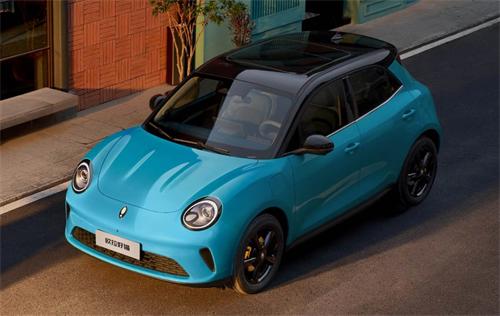
Honestly, before testing the 2025 Ora Good Cat, I had the impression it was just a “pretty car for women.” This test completely changed my perception.
The 2025 Good Cat’s trump card in China is “price drop with added features.” The car I drove was the Premium Edition, officially priced at 129,800 RMB(≈ $18,800 USD) but with a limited-time promotion of just over 100,000 RMB(≈ $14,500 USD). At this price, a 430 km-range refined EV is highly competitive.
Powertrain-wise, the Premium Edition uses a 126 kW motor with 250 N·m peak torque. For city driving, this is more than enough. I drove from Jing’an Temple in Shanghai to Pudong Airport, approximately 50 km, and mid-range acceleration (60–100 km/h) was quick, with overtaking effortless. The 45.9 kWh LFP battery provides a CLTC range of 430 km. My real-world energy consumption was around 13.5 kWh/100 km, ideal for urban commuting.
The real surprise was the cabin upgrade. The 2025 model abandons the old dual-screen layout, replacing it with an independent full LCD instrument cluster and a floating central touchscreen. This is a very wise change. The previous dual screens reflected heavily under sunlight, and the black edges between screens were distracting. The new design offers a wider view, and the central screen is better positioned in the driver’s line of sight.
The infotainment system upgraded to Coffee OS 3, featuring a large memory configuration of 16GB + 128GB. During use, with navigation, music, and voice assistant running simultaneously, the system remained responsive. Impressively, it supports screen mirroring for over 95% of smartphone brands—I tested it with a Xiaomi 14 Ultra, and the connection was smooth.
On the intelligent driving front, the ORA-Pilot system impressed me. In a Shanghai Nanjing Road underground parking lot, I tried the full-scenario automatic parking function, and it quickly and accurately identified spaces, parking flawlessly in one attempt. For users navigating tight urban parking, this feature is extremely practical.
What Do Overseas Users Get?
The Ora Good Cat has had a bumpy overseas journey. It is often sold as the “GWM Ora 03” or “Funky Cat.”
In the UK, the Ora 03 typically has a 48 kWh battery with a WLTP range of about 310 km—much shorter than China’s 430 km CLTC range. Brazil shows a similar trend: the 2024 GWM Ora 03 Skin uses a 126 kW motor, but the base version lists only 232 km range (likely under specific conditions).
Market strategies also fluctuate. According to multiple European automotive media reports, early European sales as “Funky Cat” drew attention, but due to high pricing and adjustments, sales underperformed, with some channels modified. This contrasts sharply with China’s aggressive “price slasher” strategy.
Autocar’s late-2024 review noted that the Ora 03 “is attractive in design, but charging speed and intelligent features show no clear advantage compared to European competitors in the same price range”—highlighting the overseas version’s lack of localized smart cabin features.
Where Is the Gap?
I believe the biggest gaps lie in value and smart experience.
In China, a price slightly over 100,000 RMB(≈ $14,500 USD) buys a 430 km-range EV with Coffee OS 3 and full-scenario automatic parking—a very strong value proposition. Overseas, Ora 03 pricing (e.g., starting at £25,000 in the UK, ~230,000 RMB) positions it as a boutique small car, but without matching China’s depth of smart interaction.
Another detail: China-only Premium Edition 126 kW motor may be standard or unavailable overseas. This “domestic vs. international” difference has sparked discussion on forums—some Australian users on Reddit asked, “Why does China get higher power at a lower price?”
If you are in China, the 2025 Good Cat is worth considering for urban commuting, especially if parking convenience matters. Overseas, it is more suitable as a second family “fun car,” but confirm local range and smart features before purchase.
Chapter 3: Leapmotor C11
When I got the 2025 Leapmotor C11 test car, I immediately checked the specs—and my first thought was: Can you really get all this at this price?
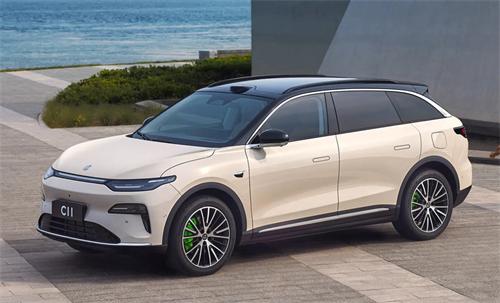
Core specs: full-domain 800V high-voltage silicon carbide fast-charging platform, 81.9 kWh battery, CLTC range 640 km, Qualcomm Snapdragon SA8295P flagship chip, 17.3-inch floating central touchscreen, 60-inch AR-HUD—and the starting price is only 149,800 RMB(≈ $21,700 USD).
I conducted a long-distance real-world test: departing Hangzhou city on the Changshen Expressway to Qiandao Lake, ~160 km. Starting at 92% battery, arriving at 65%, with a displayed consumption of 14.6 kWh/100 km—a very efficient level for a nearly 4.8-meter mid-size SUV.
The real wow factor was charging speed. On the return, I used an 800V supercharger, charging from 32% to 80% in 17 minutes, consistent with the official “50% in 18 minutes.” This was my first experience with 800V convenience at this price point. In comparison, Atto 3 fast charges at 88 kW, Good Cat 64–80 kW, while C11 is nearly double.
The cabin is another highlight. The SA8295P chip delivers superior smoothness. I zoomed maps and switched apps on the central screen without lag. The 60-inch AR-HUD projects navigation arrows, speed, and speed limits directly onto the windshield, reducing the need to look away from the road.
Leapmotor integrates DeepSeek + Tongyi Qianwen dual models for AI voice. I asked open-ended questions—“Where’s a good Japanese restaurant nearby?” “Calculate my electricity cost”—and received accurate answers. Using large models in the cabin is rare in this price range.
Intelligent driving: C11 uses 28 perception sensors with the Qualcomm 8650 chip. On highways, NAP (navigation-assisted pilot) handled lane changes and ramps decisively without frequent acceleration/deceleration. The so-called “end-to-end large model” assist driving feels closer to human habits than rule-based systems.
Chassis: front double wishbone, rear multi-link suspension, plus CTC 2.0 Plus integrated battery-chassis technology, gives solid driving feel. Over speed bumps, suspension absorbs impacts cleanly without unnecessary rebound.
Overseas Market Status
According to Leapmotor International (joint venture with Stellantis), as of June 2025, Leapmotor has ~600 overseas outlets across 30 markets, with 550+ in Europe. Currently, the main models are C10 and T03, not C11.
Top Gear’s February 2025 review notes that C10 in the UK uses a 67 kWh battery, max charging 84 kW, with average interior quality and highway cruise “room for improvement.” Compared with the Chinese 2025 C11—81.9 kWh battery, 800V platform, SA8295 chip—this is a clear generational lead.
A source close to Leapmotor International indicated that the C11’s overseas rollout may start in 2026. This means while Chinese consumers already get the “full-spec” C11 for 150,000 RMB(≈ $21,700 USD), overseas buyers still wait for the C10 at previous-generation specs.
Where Is the Gap?
Technically, 2025 C11 China edition’s 800V platform, SA8295 chip, and 640 km range will strongly challenge Volkswagen ID.4 and Škoda Enyaq once available in Europe—but “once available” is key, as it hasn’t happened yet.
Meanwhile, China’s C11 is iterating quickly. Official data shows cumulative sales exceeding 250,000 units, with 15,000 orders in the first month of 2025 launch—thanks both to tech-heavy reputation and competitive pricing.
For Chinese buyers, C11 is the strongest overall choice among the three, especially for those prioritizing range and smart features. Overseas, monitor developments—C11 may arrive in 2026, potentially putting pressure on competitors.
Final Chapter: Side-by-Side Comparison & Buying Advice
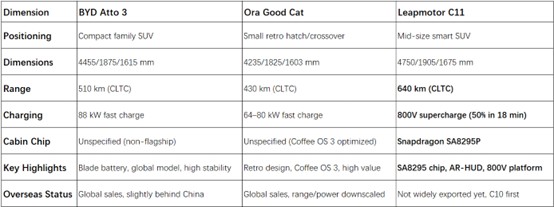
After deep test drives and domestic vs. international comparison, I summarized the core differences of the three models (based on 2025 Chinese high-trim versions):
My Buying Advice
If you value stability and resale: BYD Atto 3
Atto 3 is the most balanced among the three. Power isn’t aggressive but sufficient; range isn’t the longest but realistic; smart driving isn’t leading but stable. Verified in global markets, its reliability and resale are solid.
Note: Overseas 2025 Atto 3 has limited upgrades; in China, consider waiting for the rumored 74.88 kWh “Super Edition.”
If you mainly commute in the city and value parking convenience: Ora Good Cat
Good Cat is the easiest to drive in urban settings. Small size, nimble handling, full-scenario automatic parking—perfect for city commuting.
Drawbacks: small trunk (228 L), rear torsion beam instead of independent suspension, less comfortable on bumpy roads than C11. Not ideal for frequent highway or family trips.
If you chase tech leadership and long range: Leapmotor C11
C11 offers the strongest overall package: 800V platform, SA8295 chip, 640 km range. These hard-core specs have few rivals at this price.
Reminder: Overseas, C11 isn’t available yet. Based on Leapmotor International plans, expect arrival in 2026; once it lands, competitors at this price range will face serious pressure.
References
1. CarExpert. (2025, January). BYD Atto 3 review: Balanced choice for Australian buyers. Retrieved from [https://www.carexpert.com.au]
2. Autocar. (2024, December). Ora Good Cat (Ora 03) UK review: Design appeal but range and smart features lag. Retrieved from [https://www.autocar.co.uk]
3. Top Gear. (2025, February). Leapmotor C10 UK market evaluation. Retrieved from [https://www.topgear.com]
4. BYD Australia. (2025). 2025 Atto 3 international specs. Retrieved from [https://www.byd.com.au]
5. Leapmotor International. (2025, June). Global expansion and model rollout. Retrieved from [https://www.leapmotor.com]
About the Author
Ethan Caldwell
Ethan Caldwell is an automotive journalist and industry analyst with over 12 years of experience reviewing both hybrid and fully electric vehicles, from everyday commuter cars to high-performance sports models. He specializes in real-world testing of acceleration, handling, efficiency, and usability, providing insights that go beyond manufacturer specifications.
His work has appeared in multiple international automotive publications, and he is known for combining technical analysis with hands-on driving experience, making complex automotive data accessible to both enthusiasts and everyday buyers.
Ethan focuses on plug-in hybrids, electric performance sedans, and emerging Chinese EVs, offering comparative reviews that highlight practical ownership insights, driving dynamics, and technology usability.
Editorial Transparency Statement
This article is based on hands-on test drives, official manufacturer specifications, and publicly available automotive reviews. Any opinions expressed reflect the author’s professional analysis and personal driving experience. No sponsorships or paid promotions influenced the content.